Blog

Two Myths of the Modern World

Where there are human beings, there are myths. Myths surround us and permeate everything we do. Where we least suspect myths, they breed in greatest abundance. Science, for example, claims empirical and objective truth, but we know full well this is merely another narrative, another perspective, another myth retold in modern form; in this case, it is the myth of the great sorcerer equipped with talismans of “clearsight”, the wizard who subdues nature by virtue of knowledge.

Without myths, our lives would not only be dull, but we would also struggle to see our place in the universe. For better or worse, we are bound to our mythic narratives. They shape us.

Ted Hughes believed that at moments of crisis, “shamans” arise to give voice to the myth of their present time, to lead people through the darkness of uncertainty—perhaps when the old established myths have been too challenged and changed to be recognisable anymore. The prime example he gives is that of Shakespeare in the Elizabethan period. Shakespeare emerged at a moment of profound crisis of identity, where the twin polarities of Protestantism and Catholicism—held at bay only by the sheer force of Queen Elizabeth I’s personality—threatened to obliterate not only each other but Britain as a whole. Shakespeare’s first long-form narrative poem, Venus and Adonis, described the myth of his time—one of loss of soul, of transformation, and a Virginal Goddess—and in some sense rallied the British people to confront their own mythic crisis.

Venus & Adonis by Titian

But what are the myths of our time?

In my opinion, our time is defined by two myths that are at once distinct and deeply interlinked. The first of these myths is The Voyage Home.

The journey home features heavily in mythic narratives. Jung would no doubt have a lot to say about this ever-present desire in our psyche. The Voyage Home reflects not merely a physical journey but also a spiritual and temporal one, for home is often located in the past, in a Golden Age of innocence that has to be found again.

The Odyssey, of course, is the prime and enduring example of this myth. The hero, Odysseus, having fought for ten years at Troy, must now get home to Ithaca, to his son Telemachos and his wife Penelope, the latter of which may be a metaphor for his own soul. But he is waylaid, transformed, and, when he finally arrives home, is almost unrecognisable. But this change proves good, for his pride has at last been humbled. His reunion with Penelope is all the sweeter for his travails.

It seems no coincidence that a slew of film adaptations of The Odyssey have emerged in recent years: The Return, starring Ralph Fiennes, and Christopher Nolan’s forthcoming movie spring immediately to mind.

But there have been other more radical takes on this mythic narrative, and I believe one in particular might be considered our very own Shakespearean, shamanic iteration—the supreme rendering of the myth for our time. I’m speaking, of course, of David Lynch’s Twin Peaks: The Return.

A direct reference to the myth of Orpheus is present in "Twin Peaks: The Return", because Dale Cooper looks back at his Eurydice, and thus condemns her to oblivion.

Twin Peaks: The Return is, as its name suggests, all about coming home, about returning to a past Golden Age that has been somehow lost or corrupted. Like The Odyssey, Twin Peaks: The Return takes us on a voyage in which our hero and his crew are beset by monsters—doppelgangers in particular—and trials. These tribulations are physical, emotional, and spiritual all at once. But unlike The Odyssey, the tragedy of Twin Peaks: The Return is that in the end it is not possible to find our way home. Lynch’s beautiful but also terrifyingly nightmarish vision is one that exposes perhaps the primary fear of our time: that things are only going to get worse (we might meditate on the title of the best-selling book by Eric Larocca, Things Have Gotten Worse Since We Last Spoke, as a kind of emblematic catchphrase of our time).

Twin Peaks: The Return is about many forms of voyage home: a return to the town of Twin Peaks which represents an idyllic country America, a home that perhaps no longer exists; Dale Cooper’s return to reality, and his own body (another home), after years trapped in the Red Room; and, in the meta sense, the return of an old ‘90s TV show to television (the home where it belongs). Lynch, however, never relies on meta as a way out of meaning. His films work similarly to Shakespeare's plays in that they operate on multiple levels. They are self-aware but not to the extent that they are empty, just enough to remind us that “We live inside a dream” and “All the world’s a stage.”

Through the 18-part series, the increasing isolationism of the modern world is laid bare. Our heroes are those who try to keep the connection alive, but the price of lacking that connection is all-too-apparent. The series is at once a longing for a past time before the Fall—which Lynch seemingly locates in a black and white 1950s—and an Orphean warning of the perils of looking back, lest we not only lose the past but also destroy the future. Its final image is one of total confusion, despair, and uncertainty, in which our heroine Laura Palmer—the lost Penelope—can only scream.

The final image of "Twin Peaks: The Return", a harrowing yet strangely rousing scream, a scream, perhaps, to shake us from sleep.

While it may sound harrowing and negative, Lynch sincerely believed in the power of love. But he would not let that optimistic belief soften his warning to the world. Twin Peaks: The Return was Lynch’s last fully-fledged cinematic gift, an astonishing opus designed to shake its viewers out of the sleep into which they have been lulled by the forces of darkness. We must be grateful to him for it.

The second myth that defines our time is The Old Gods Returning.

The Returning King or God is a powerful myth that has existed seemingly since the dawn of time and will likely continue to exist until the ending of the world. It has found potent iterations in the myth of Osiris and King Arthur—the latter of which is still very much alive today in Glastonbury! Though echoed time and again across many cultures, the most powerful expression of this myth is almost undoubtedly the Christian story.

But what I now see emerging is a new variation on that myth. There has, in recent years, been a resurgence of Paganism. The Norse and Greek gods in particular seem to be finding currency again: in popular literature, movies, television series, as well as occult circles, New Age thought, and beyond.

A particularly striking example of this Pagan resurgence can be found in the film Mandy by Panos Cosmatos. In Mandy, Nicholas Cage plays the role of Red, who we slowly realise throughout the film is likely not human, but in fact a god living out a quasi-mortal life with the woman he loves (as the Greek gods were often want to do). He is described as “A Jovan warrior from the eye of the storm” (a line of pure poetry if ever there was one). Throughout, Red draws comparisons with Jupiter—not just the planet, of course, but also the Roman deity, the equivalent of the Greek Zeus. In one startling scene, Red sets a Christian church on fire to utterly destroy a hive of evil Christian evangelicals.

Christianity burns in "Mandy" as the old gods return for vengeance and to awaken the primordial currents of life.

The symbolism is clear: the old gods have awoken again, and they are pissed.

The occultist Kenneth Grant predicted this resurgence when he founded the Typhonian Order of the Temple of the Orient—“Typhonian”, of course, referring to the horrific titan-beast Typhon who made war on the “new gods”. Those new gods are now themselves old, largely replaced not only by a monotheistic paradigm but also by technological and scientific narratives. However, it seems that the gods are not going to take their banishment lying down, and thus they move among us stirring new fantasies and creations. The Pagan gods are back for blood.

Understanding the myths of our time can help us to perceive the truth of where we are—and how to move forward. Lynch saw plainly that the way back is impossible. Pining for a fictionalised past, or worse trying to change the past (revisionism), will only cement our destruction and loss of soul.

Cosmatos, on the other hand, tapped into the current of Pagan resurgence that speaks to repressed animalities re-emerging with Freudian impetus to remind us of who we are at root. Both of these myths speak to the bitterness of nostalgia, the power of fear, and promise the upheaval of our reality. A new reality beckons, but it is not like the home we once knew; the gods have returned, but in new, more darkly wondrous forms than we ever imagined.


"A Jovan warrior from the eye of the storm." - Mandy

Be warned, then. If we are ever to find our way home, we first have to make peace with these old gods, these old demons, these lingering titans, whom we have tried and failed to exile from our world (and minds). If we cannot, then the result will be what Lynch described as the most frightening thing in the world: “The possibility that love is not enough.”
Blog

Entering Carcosa Part 8: Deadly Premonition

Hello my dear friends. Entering Carcosa has returned from beyond the veil. For those who don’t know what Entering Carcosa is, way back in 2018 I started up a series of articles talking about modern epics in unconventional mediums, such as videogames, anime, and anthologic series. There were seven installations in this epic series before I finally called it a day; seven seemed apt as it’s a divine number, and a number intimately connected with the epic. For example, epic heroes have seven key qualities1.

However, I recently had an experience so earth-shattering that I’ve been compelled to reopen the warped gateway to Carcosa and add one additional entry: Deadly Premonition.

For those who know what Deadly Premonition is, you may be scratching your heads; can it really be considered epic? But trust me, if any narrative has earned its place in the halls of dim Carcosa, home of the epic, it’s this unconventional masterpiece by the mad genius SWERY65.

So, what is Deadly Premonition? In short, it’s a 2010 videogame released exclusively for the Playstation 3 (it subsequently was re-released in various formats, including a Director's Cut, which is the version I played). It had one of the most divisive launches of any videogame in history, with players at loggerheads over whether the game was a strange masterpiece or a janky failure. Over time, the game and its creator has developed a cult following, and Deadly Premonition has become legendary in the industry as one of the most unique and original games ever made.

When I settled down to play Deadly Premonition, albeit twelve years late to the party, I knew something of what to expect. Or so I thought. I’d seen clips of the game on YouTube. I’d seen memes made out of some of the game’s more esoteric or gonzo moments. But the truth is, as Morpheus says to Neo in The Matrix, “There is a difference between knowing the path, and walking the path.” And, “You cannot be told what The Matrix is. You have to be shown.” I’d been told a lot about Deadly Premonition, I knew a lot about the game, but honestly none of that could prepare me for what I experienced.

For those used to more traditional game-reviews, this article is not going to go deep into gameplay mechanics—although there is a lot to be said about them. This series is about epics and narrative, and so we’re going to keep pretty focused throughout on what makes the story of Deadly Premonition, and how it’s unfolded to the player, so special.

The premise starts off in a relatively familiar fashion. FBI agent Francis York Morgan is dispatched to an isolated town in rural America called Greenvale. A young woman has been murdered in a particularly brutal fashion, and York is something of a specialist in cases involving the murder of young women. The reason for this is twofold: firstly, he’s an expert profiler who understands the psychology behind the killers, especially killers who prey on vulnerable girls; the second reason, of course, is a deep personal motivation which is only revealed towards the middle of the story.

Detectives—which is essentially what York is—are really the equivalent of the knight-errants of classical literature. Knights are men and women bearing special badges of office and talismans of authority, charged with a quest, something they have to go out and seek by whatever means they have available to them. Detectives are no different. They are special individuals granted a badge of office and weapons that allow them to go out and seek the object of their quest. In most cases: the Truth. This is quite an intriguing development of the quest theme because it allows the quest to unfold not just spatially but also chronometrically, aka, across the sands of time. This is very relevant for discussing Deadly Premonition, which is incredibly preoccupied with our relationship with time.

But to come back to knights, in other words, we have an archetypal setup: knight on quest, detective on mission. However, York is anything but conventional, and the quest he is about to see to its dark conclusion is metaphysical, spiritual, indeed, even cosmic.

Let’s explain why York is so unconventional. Please note this is going to involve spoilers, so if you want to go into Deadly Premonition blind, then please stop reading and enjoy on your own terms! In honesty, it’s probably the best way to experience the game. However, if you don’t have a PS3 or aren’t likely to play it, then enjoy my all-too-brief examination.

There are two things about York that make him such a unique and fascinating character. Firstly, there’s his weird and wonderful mind. Our introduction to York sees him driving down a rain-slick highway towards Greenvale. He’s on the phone with one of his FBI superiors. He’s discussing a case, or at least that’s what we think. He describes how the victim is in an abusive relationship.

“They both need each-other. It’s called interdependency. Yeah, I know. He does terrible things to Tom. Nasty, even sadistic things. But that’s fine, as long as that’s what Tom wants...”

About mid-way through York’s monologue, you realise he’s talking about the cartoon Tom & Jerry. I laughed out loud at this. But while it’s a hilarious gag, and instantly locates York as a kind of obsessive nerd with glimmers of genius, it’s also a subtle foreshadowing of what’s to come. Indeed, a terrible co-dependent (or interdependent as York terms it) relationship is at the heart of the villainy plaguing Greenvale, and one of the members of this relationship is even called Thomas!

So, York’s whacky mind, which draws comparisons with unconventional sources, is one point of interest about him. But if that were not enough, he also talks to himself. Or rather, he talks to an imaginary friend called Zach. This is perhaps one of the most powerful and important aspects of the entire story. On a surface level, Zach basically seems like a cipher for the player themselves. York calls on Zach for guidance, and as we—the player—are literally “controlling” York in the game, there’s almost a sense of Zach being the guiding hand of the player upon him. This meta-device doesn’t come across as pretentious, however. Instead, it establishes a kind of delicate intimacy between York and the player. Suddenly, you feel very responsible for York, like he is baring his very soul to you. It’s also a good excuse for York to explain complex ideas very directly to the player. Lastly, it’s also played for a few laughs: picture if you will the anxious inhabitants of Greenvale when they realise that their supposed expert FBI investigator has an “imaginary friend” advising him on the case!

If this were all Zach was, it would make for great entertainment. But just over halfway through the story, we realise Zach is something more. Indeed, the revelation of what or who Zach is, is perhaps the most astonishing scene in the whole game. Although, having said that, it has stiff competition, because there are at least four or five other moments of sublimity that indelibly leave their mark. But I’m skipping ahead.

York explains to Emily—the deputy Sheriff of Greenvale and a woman whom he slowly starts to develop feelings for throughout the story—that when he was seven years old, his father killed his mother then put the gun to his own head and committed suicide. York witnessed the whole thing. In the depths of this tragedy, however, York heard a still, quiet voice, like Elijah does in the Old Testament. The voice said, “I am here with you. I will always be here with you. You are not alone.” The voice comforted the traumatised seven-year-old York and became his companion ever since.

I confess the revelation Zach is not merely a narrative joke, but connected to something so deeply traumatic, so deeply moving, so deeply spiritual, shocked me into floods of tears. I thought I understood what Deadly Premonition was: a zany horror game with great dialogue and janky mechanics. But this made me realise Deadly Premonition was going to offer a lot more, it was going to become a spiritual journey.

And indeed, there’s even more to say about Zach. In the final terrifying confrontation with the evil at the heart of Greenvale, where York must face an impossible choice, we realise that York’s memories of the event of his parents’ death are not entirely accurate. He has suppressed one truth because of the pain. The truth is that he was originally Zach. Zach is his real name and his childhood self. His pure and uncorrupted divine self. York is the bitter and hardened armour he has built around it. York is essentially a personality construct, an image Zach has made up that fits his idea of what a “man” or “detective” should look like. Zach is the true version of himself, a vulnerable and scared version, an inner child.

If you're paying attention, you'll realise that this "interdependent" relationship between York and Zach is a mirror of the evil interdependent relationship foreshadowed by the Tom and Jerry joke at the start of the whole story... Premonition indeed. And this, of course, means that unlike the villains, who are stuck in their ways, York and Zach have to change, which leads us to arguably the most incredible moment of. the whole story, a moment that took my breath away.

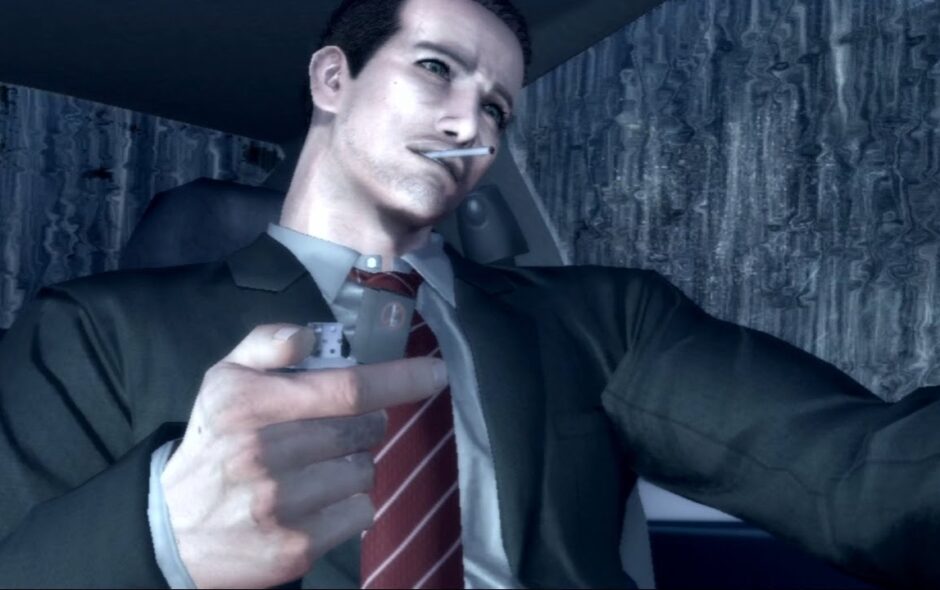
At the crisis point, the protective personality construct, York, recognises the spiritual danger faced by Zach and Emily, recognises that the inner child might be finally killed if he does not act, and sacrifices himself to protect the inner child. It’s a moment of astonishing beauty and pathos. It not only has massive psychological implications, for don’t we all have these armoured shells we use to deflect pain, and aren’t there always situations that cause us to make difficult choices about them? But it also has Jungian and metaphysical meanings. York is Zach’s projected self, a cigarette-smoking anti-social persona. But he is also a protective angel constructed from a child’s terrified imagination. Throughout this story, York has acted like a guardian angel, shouldering the burden of horror and pain so that Zach doesn’t have to. But in the final moments, Zach must stand on his own and face the very evil that scarred him in the first place. I don’t think I need to use any of the technical terms surrounding epic literature to convey the simple fact that this is epic, cathartic, even sublime.

These examples all come from the main story of Deadly Premonition, the meat and bones, but the brilliance is that just as much loving attention and detail was paid to the minor characters and side-plots (bear in mind that all good epics must show scale and scope). Indeed, there is a b-character called “The General” who owns a junkyard, and does car repairs. York notes early on that “The General” is actually wearing a Sergeant’s insignia, and begins to suspect that most of The General’s war stories are in fact bullshit. Over the course of the game, you can run errands for The General, and each time you complete one he will fix up your car (which has in-game benefits) and share another war story.

The General tells us three tales. The first is exceedingly comic, centred around soldiers nearly dying from diarrhoea. The second is a little more grounded, in that it details how the soldiers failed to make an attack upon an enemy base in time, which resulted in mass casualties. In both of these stories the General repeatedly expresses his hatred for their squad’s Sergeant, a man called Timothy, whom the General refers to as “cry baby Timothy”. Timothy is one of those officers with very little military experience, elected due to their degree qualifications and little more. Timothy continually exhibits behaviours of cowardice, which enrages The General even in memory. York notes, however, that the General spends a lot of time talking about Timothy considering how much he supposedly hates him… The third story reveals the truth of the matter. The General nearly died from dehydration during one particularly gruelling battle. He collapsed and blacked out. When he awoke, there was water on his face and in his mouth. A body lay next to him, dead. Thesoldier had run back and forth between a puddle and carried water to The General’s parched lips. It was “cry baby Timothy”. He was shot dead saving The General’s life. The General could not psychologically reconcile the man he hated and thought of as a coward with the man who risked his life to save him. Hence, The General’s contrary,cantankerous, and divided nature, and why he wears a Sergeant’s lapel even though he eventually rose to a much higher rank. If this isn’t genius writing, I don’t know what is.

And that’s just one of the many side stories you can find in the town of Greenvale. Deadly Premonition is a treasure trove. Every time I thought I had exhausted a character’s dialogue they gave me more. Every time I ran an obscure errand for a character, I told myself the payout would be trivial, and yet I was rewarded time after time with depth: dialogue, cutscenes, story, and all of it interconnected, all of it adding up, all of it becoming part of this glorious whole. Indeed, in any great story, every microcosm reflects the whole. This is important, especially when Deadly Premonition takes on such deep themes.

And what are these themes? It would be easy to see Deadly Premonition is a bit of an eclectic mess, equal parts Twin Peaks, Japanese anime, and True Detective (although Deadly Premonition actually came out four years before True Detective, and I can't help but see parallels—the opening shot of True Detective's first episode is almost identical with the opening of Deadly Premonition; was Nic Pizzollato inspired?). However, despite the mix of tones and influences, the narrative is remarkably cohesive, and focused on two core themes (which themselves are interrelated). 

The first of these is quite obviously Time. It’s a suitably epic theme, explored by many of the world’s greatest poets and writers. If there’s any doubt Deadly Premonition is fixated on time, consider that one of the climactic showdowns of the game happens inside a clocktower, and indeed, the clocktower is a location we return to time and time again throughout the story, at one point travelling back in time to witness an event from the ‘50s that shaped the town forever. Quite apart from the game mechanics themselves, which forces us to establish a relationship with time via a real clock you have to adhere to (in other words, you have to be certain places at certain times to see things happen – shops open at regular hours, and all the townsfolk obey their idiosyncratic routines), the narrative of the game is brimming with explorations of what time means. The mysterious capitalist (those are the exact words used to introduce him—you have to love the sense of humour) Harry Stewart, for example, tells York that he became rich because he understood timing. It’s not about how fast you do something, it’s about doing it at the right moment. York is constantly—and counterintuitively—slowing down during his investigation, rather than rushing, which infuriates many of the townsfolk and the other police officers. However, his unconventional methods produce results. By moving backward we move forward. This is one of the primal underpinning qualities of an epic, for all the true epics understand the bidirectional relationship with history necessary to create a cultural artefact.

The other key theme of Deadly Premonition is in the title: Premonition. Magic, divination, sixth sense, and all of this occult goodness woven into the quotidian fabric of everyday reality. Whilst undoubtedly SWERY learned a lot from David Lynch’s Twin Peaks in this regard, SWERY’s magic has its own unique flavour. Indeed, though York uses rational deduction and psychological profiling, most of his methods of detection are entirely esoteric, which comes in handy, as his enemies are also using supernatural means to achieve their ends. The intermixture of ordinary and occult is no better typified than by York’s coffee, which has an uncanny knack of predicting the future. One senses that SWERY sees the magical in everyday life and understands that every person has their own idiosyncrasies that allow them to have a relationship with the universe. The genius of the writing is the empathy with which these idiosyncrasies are rendered.

But more than this, premonition is also connected to destiny, and a sense of destiny—or fate—pervades Deadly Premonition. York (or should we say Zach) is meant to come to Greenvale. Indeed, the evil at the heart of Greenvale is directly connected to his tragic past and the mysterious scar that warps his hairline. Only York can cure Greenvale’s sickness. The ultimate victory of good over evil—though won at a heavy price—is written in the stars (and shown in the swirling milk within the coffee cup—as above, so below!). The ending of Deadly Premonition therefore feels not only earned but inevitable—and like all great epics, will probably stay with me for as long as I live.

***

If you enjoyed this article, and want to see more, then please consider becoming a Patron, where you’ll get access to exclusive articles, videos, and conversations exploring literature, the occult, and more.

Footnotes

1They are from an unusual place or land, they have an unusual power, they usually have a keen sense of justice (even if it is a warped one, such as Satan in Paradise Lost), they possess magical weapons or equipment, they are in some way royal, or dispossessed of something that belonged to them, they are often orphaned or not raised by their true parents, and lastly, they possess a tragic flaw or weakness.

Blog

Review of Spontaneous Human Combustion by Richard Thomas


Spontaneous Human Combustion is Richard Thomas’s fourth short story collection, featuring 14 tales ranging from cosmic horror, to science fiction, fantasy, and into realms beyond any simple definition. Richard Thomas has a unique style of writing, a trademark syntax that I can spot a mile away, though at the same time he is also chameleon-esque, changing the style and flavour of his prose in order to suit the aesthetics of his story, or to further highlight a theme he is exploring. This is perhaps why he is such an adept of the short story form in particular (though I do adore his novel Disintegration in particular). 

Stephen King describes short stories as “a kiss in the dark” and Richard Thomas exemplifies this transitory (and sometimes transcendental) experience, in which the very brevity of the form becomes the source of its power. We can only connect with the divine momentarily. Yet, to do so can be life-changing. In this way, Richard Thomas’ short stories more closely resemble poems. They do not always operate on the plane of conscious understanding. They are not meant to be comprehended through rational intellect, but to touch something lying beneath that. I found some of the stories in this collection to be moving without really understanding them in full. This collection also took me twice as long as it should have done to read because I was drawn inexorably to re-read virtually every story in the collection (and was rewarded every time with new insight)! 

I am fairly sure that this collection will be divisive in multiple ways. Some people will hate the poetic styling. Some will love it. And beyond this, there is unlikely to be any consensus on what the best story in this collection is. The range on offer here prohibits an easy narrowing down. As I mentioned earlier, Richard Thomas touches on virtually every speculative genre known to humankind, and combines them in often unexpected ways. Secondary world fantasies give way to dystopian science fiction. Lovecraftian horror is mixed with hope-punk. One senses a mind behind all these stories striving relentlessly for originality, to forge something new and not rely on tropes or easy wins. In the extensive and enlightening Endnotes at the back of this collection, Richard Thomas often mentions “challenging himself”, and one can feel that these stories are an almost Barker-esque attempt to discover something beyond the mundane, to “[explore] the further reaches of human experience” (Hellraiser). There is an experimental nature to this which is by definition inexact, but can produce startling alchemy. 

As I have said before, the experience will be highly personal, and no doubt there will be little agreement on which are the most potent stories in this collection, but I will highlight my own personal top four to give you a flavour of the book:

“Ring of Fire”

I would be criminally remiss not to mention this story, as it is the longest in the collection, practically a novella. It was first published in Seven Deadliest Sins, an anthology of seven novelette / novella-length works that centred on the eponymous Seven Deadly Sins, so I had read the story once before (my review of this collection can be found here:https://storgy.com/2019/05/29/book-review-the-seven-deadliest-edited-by-patrick-beltran-and-d-alexander-ward/). “Ring of Fire” is a little bit like a Lynchian Möbius strip, a circle that doesn’t quite complete, a mystery that forever unfolds but never quite solves; at the same time, it’s a tremendous character-arc. It is a slow burner, in which the seemingly explainable and mundane scenes we’re privy too are steadily re-contextualised until we realise that nothing has been “normal” or “explainable” from the start. It is also carries an indescribable sadness to it, as each repetition, each “circuit” of the Möbius, seems to lead us not towards salvation but deeper into the elliptical loops of the psyche. It’s worth mentioning this is not the only story in the collection that involves repeated scenarios or looping narrative. There are several “Groundhog Days” contained in Spontaneous Human Combustion. Some are literal, some spiritual, and others more subtle, but the idea of being stuck in a loop that either cannot be broken, or can only be broken by our most extraordinary efforts—with great sacrifice—is arguably the defining image of the entire collection, and a metaphor for the human condition. 

“The Caged Bird Sings In a Darkness Of Its Own Creation” 

This is another story that I’d read once before; it was first published in Storgy’s Shallow Creek anthology, one of the weirdest and most underrated collections of fiction ever put to print. You can also read my review of that collection here: https://themindflayer.com/review-shallow-creek-storgy/. Richard Thomas’s story is the last story in the collection, and for good reason. It is a total mind-f*ck of chthonic proportions. It centres on Krinkles The Klown, who is a kind of Pennywise for Shallow Creek. But rather than going for shock-horror and killer clown antics, Richard Thomas instead tries to peel back the laters of Krinkles and show us why he is so strange (interestingly, there is another story in Spontaneous Human Combustion about a clown taking off their makeup—I sense a theme emerging!). I do not normally enjoy narratives that leave so much in the reader’s hands, but what I loved about “The Caged Bird Sings In a Darkness Of Its Own Creation” is that Richard Thomas give us a series of choices, and we realise that this is exactly what Krinkles has faced: a series of choices, bargains, and decisions that have led him to the edge of the abyss. The story can be seen as bleak, in some ways, but is this how Krinkles sees it? Richard Thomas shows us that perception is everything in this tale. What we choose to see in the mirror is the reality we inhabit. The story has two strange parallels: Twin Peaks, especially Part 8 of Twin Peaks: The Return (in which the macrocosm of the Lynch-universe is seemingly unveiled); and secondly, Close Encounters Of The Third Kind. In terms of the second comparison, not so much the retro late-seventies vibe, more the contact with something entirely other, and the sense of obsession, panic, and euphoria such contact can bring. 

“Nodus Tollens” 

This story was a huge surprise. It is almost an outlier of the collection, in that it is written in a more prosaic and down-to-earth style. Richard Thomas himself described it as his most “King-like” story, and I would have to agree. As much as I love Richard Thomas’ impressionistic bent, it was refreshing, indeed electrifying, to see him tackle a story in a more grounded way, and as a consequence the story stands out. The title, Nodus Tollens, is a phrase invented by John Koenig on The Dictionary of Obscure Sorrows which means “the realization that the plot of your life doesn’t make sense to you anymore”. Thus, what starts as a simple hand of poker quickly becomes a cosmic game in which sin must be unburdened. 

“Undone”

This story was the biggest surprise in the collection. When I first started reading it, I was uncertain whether I would enjoy it. Essentially, and I don’t think this is not giving away too much, the entire 1,500 word story is written in one sentence. Usually, I would regard this as pretentious; however, Richard Thomas pulls it off, for several reasons, perhaps the most important of which is that the frenetic, relentless nature of the single run-on sentence is used to encapsulate the relentless nature of a terrifying, heart-pounding chase. This clever mimesis justifies the technique and elevates the intensity of the narrative. The plot of the story is simple, or seems to be. Two people are running from something unspeakable. What emerges at the end of the tale, however, is a moment of transcendence, of contact with something ineffable and divine. It is weird, grotesque, beautiful, harrowing, and spiritually uplifting. There are shades of China Miéville here. Never in a million years could I have guessed this would be my favourite story in the collection, but it is. 

Spontaneous Human Combustion is not easy reading (to be fair, in general I do not find collections easy to read due to the stop-start nature of digesting a series of stories); however, it is a rewarding and powerful experience on so many levels. Richard Thomas pushes the envelope of what is possible in fiction, and strives to show us something truly sublime. Perhaps the collection is best summarised in Richard Thomas’s own words from his story “Undone”: “everything I could never be, nothing we have been before”. 

You can pre-order the collection here:

Amazon UK

Amazon US