Blog

Review of There’s Something Here From Somewhere Else by Jonathon T. Cross

Sometimes, a title just reaches out and grabs me—and I have to buy the book. This was the case with There’s Something Here From Somewhere Else. It’s a perfect encapsulation of cosmic horror’s foundations: a fear of the Other, of what’s Out There.

These themes are woven through this cosmic horror novella. Jonathon T. Cross is clearly a fan of classic Lovecraftian fiction, and There’s Something Here From Somewhere Else reads like it could have been penned by Lovecraft. Whereas Jonathon T. Cross’s other cosmic horror story, Cthulhu’s Lure (which I reviewed here), is set in the modern day and reimagines the mythos through the lens of internet cults and modern celebrity, There’s Something Here From Somewhere Else is more straightforward and old school. Set in the 1950s, the story centres around a girl called Lydia whose family have recently moved to a village in the swamp. Local legends surround the place about a creature known as The Lurker. Herbalism and witchcraft are rife here. Law enforcement exists, but the town seems to prefer its own brand of lynch-mob justice. Lydia hates it here, and it’s easy to see why.

The swamp is a perfect backdrop for a tale of cosmic terror. There are very real monsters in the swamp—gators, as one example—and the people there have been hardened by their difficult existence.

But just when Lydia’s life seems to become unbearable, a doll appears. The doll looks just like her, like it was made for her. The doll brings her comfort. The doll might just have otherworldly powers…

What enfolds is a story that centres around perception. Where Jonathon T. Cross diverts from Lovecraft is his interest in perspective and truth. Lovecraft’s protagonists are almost invariably scientifically minded individuals—or fully fledged scientists—who inch closer and closer to the truth by means of their scientific methodology. The truth invariably destroys them. Lovecraft’s imagery speaks to an underlying obsession in the unconscious mind of the human race. Lovecraft described it as “fear of the unknown” but in actual fact his fiction exposes that far from it being unknown we already know this truth and will do everything in our power to avoid confronting it. When forced to face it, we are utterly destroyed.

Jonathon T. Cross, on the other hand, presents a more muddied picture of truth (again, the swamp forms the perfect symbolic backdrop for this!). The muddying of truth is woven into every facet of the narrative. Lydia’s parents are not who they say they are. The mysterious witch who lives “out in the fog” and keeps a pet wolf is not who everyone thinks she is. Lydia’s rescuers are not who they say they are. Lydia herself is not who she thinks she is. The whole narrative we are reading is not what we think it is.

The fear in the story doesn’t really come from The Lurker, so much as the instability and deceits of the human mind. When we cannot rely on our eyes to truly see or our ears to truly hear, then who is to say we do not live in a world of horrors. The recurring motif of There’s Something Here From Somewhere Else is safety found and then taken away again. There is no harbour, no port in the storm. That is because the sickness lies within. The horror—the cosmic invasion—has occurred at a psychological level, where we cannot even run from it.

If I have one criticism of the novella, it’s that at times the narrative relied on “telling” rather than “showing”. Conversations, for example, were often delivered in blocks of narrative prose rather than letting us hear the actual dialogue. Given the themes of the story, this works slightly against the book. Having said that, the story is still atmospheric, intriguing, and pulls off a great denouement.

Jonathon T. Cross is establishing himself rapidly as a fine purveyor of cosmic horror fiction that respects the tradition but also adapts it; his work merits a great deal more attention.

You can purchase There’s Something Here From Somewhere Else on Amazon:

Amazon UK

Amazon US

Amazon CA

Blog

Review of When I Look At The Sky, All I See Are Stars by Steve Stred

I’ve heard several authors and critics say that When I Look At The Sky, All I See Are Stars is Steve Stred’s best book, and it is easy to see why: the Canadian horror-maestro pulled out all the stops for this one. This compact novel contains psychological horror, mind-warping unreliable narration, cosmic horror, dark fantasy, and demonic possession. It also contains some of Stred’s most beautiful and evocative prose to date. For example, during a disconcerting flashback scene—though we question the reliability of the narrator—the character Richard is described as “speaking through the mud of a dream.” This image is not only exquisite in its own right, perfectly describing that slow, hypnotic speech that can come from shellshocked or traumatised individuals, but it also stands emblematic of the whole story. When I Look At The Sky is a dream, of sorts, told in a dreamlike fashion: jumping between perspectives, wrong-footing assumptions, and leaving much unsaid. The effect of this is total disorientation, a nausea of the mind that makes us feel like we, too, are being assailed by dark forces in daring to read this profane work.

The story premise centres around psychologist Dr. Rachel Hoggendorf and her newest patient David Stewart. David appears to be an extreme case of multiple personality disorder ah la M. Night Shyamalan’s Split. He talks to himself, even interviews himself, and is constantly reciting lengthy letters (allegedly from memory). However, things take a dark turn when it is revealed that David knows information about Rachel that no one else knows, a trauma from her past that went unwitnessed and unconfessed. Could he, therefore, be a genuine case of demonic possession?

From this starting point, Stred takes us deeper and deeper down the rabbit hole. We dive simultaneously into David’s past as Rachel tries to piece his increasingly fantastical story together, and in turn, through David’s reverse interrogation, we find out who Rachel really is. This leads to a horrifying turning point in the novel which I cannot say more about for fear of spoiling the story, but suffice to say, Stred’s disorientation tactics pay dividends. Ultimately, one of the key themes of When I Look At The Sky seems to be whether we can ever truly know who we are. What defines us? Is it our actions? Is it our memories? Is it our commitments—what we choose to make contracts with?

But what if we are not in control of our actions? What if we cannot trust our memories? And what if we have no choice but to make a pact to survive? Stred explores people who are at the edge of sanity and desperation, who throws themselves upon powers they neither know nor understand. This is what it means to exist in this world of flesh and blood. To use Stred’s own words, “flying forward into the chaos of discovery.”

Another thematic exploration of When I Look At The Sky is the relationship between evil and madness. Unlike most writers, who equate madness or mental disease with evil, Stred takes a far more nuanced and subtle approach. The evil force in his novel is, in fact, extremely wilful and intentional. It is thinking very clearly. However, contact with the intensity of this evil tends to drive people insane. The insanity is not the cause of the evil but the byproduct of it, much like Lovecraft’s protagonists, who go insane because of their inability to comprehend the eldritch deities of the cosmos.

“When he looked Father Selinofoto in the eyes again, he saw an evil burning deep within the pupils, an evil that caressed some part of his subconscious.”

Stred frequently uses fire and flame imagery to describe hatred and evil. Whilst it would be easy to think that this is simply a cliched “hell fire” reference, I actually think Stred is doing something far deeper. Evil burns—uses up—those it inhabits. Those who are “possessed” or taken over by these demonic forces are battered and broken and burned out. They are simply tools to be used until they break and then are discarded. In this way, madness actually becomes an escapism—a refuge—from the forces of evil.

“I was a slave to both sides. A man stuck barking at the moon for reprieve.”

The moon, of course, has always been a symbol of madness—hence the word “lunatic”. The moon has two sides or “faces”: one we can see, and one we cannot see. It is therefore the perfect symbol for Stred’s story, which is all about trying to find the hidden face beneath. Everyone in this story has a hidden face. At times, characters may seem to change their motivations suddenly, which can be jarring, or even make you think Stred has made a mistake. But upon reflection, I think Stred is really drawing our attention to the duplicity of man’s nature. Interestingly, the moon appears prominently at two key moments in the narrative, both of which herald a cataclysmic change in the psyche of a main character.

The last thing I want to mention is perhaps surprising: in this novel, more than any other he has written, Stred demonstrates a fantastic sense of humour. There are several moments in the novel where, in order to break the tension or highlight a particular irony, Stred made me laugh out loud. He recognises that there is an inherent element of absurdity in the Lovecraftian genre, and uses humour to at once underscore that but also lull us into a false sense of security.

“Nothing’s making sense here, Carl. I would rather be prudent and make sure I don’t end up babbling about space monster cocks in my ass.”

This is certainly not a humorous horror novel in the vein of Grady Hendrix or anything like that. But there are moments of unexpected levity, such as the above, that serve to make the scary bits even scarier.

Ultimately, When I Look At The Sky is a harrowing descent into the psyches of two people coming apart at the seams. It is a schizophrenic book that undermines all certainty and forces us to confront the unknowable aspects of our nature, including forbidden desires. In truly Clive Barker fashion, one character remarks: “I’ve done all I could, taken my desires as far as they could go.” When I Look At The Sky, All I See Are Stars takes us as far as we can go, into depths of horror midnight black that yet reveal shining constellations of meaning.

You can purchase When I Look At The Sky, All I See Are Stars at the below links:

Amazon UK

Amazon US

Amazon CA

Blog

Review of Madness From The Sea: Cthulhu’s Lure by Jonathon T. Cross

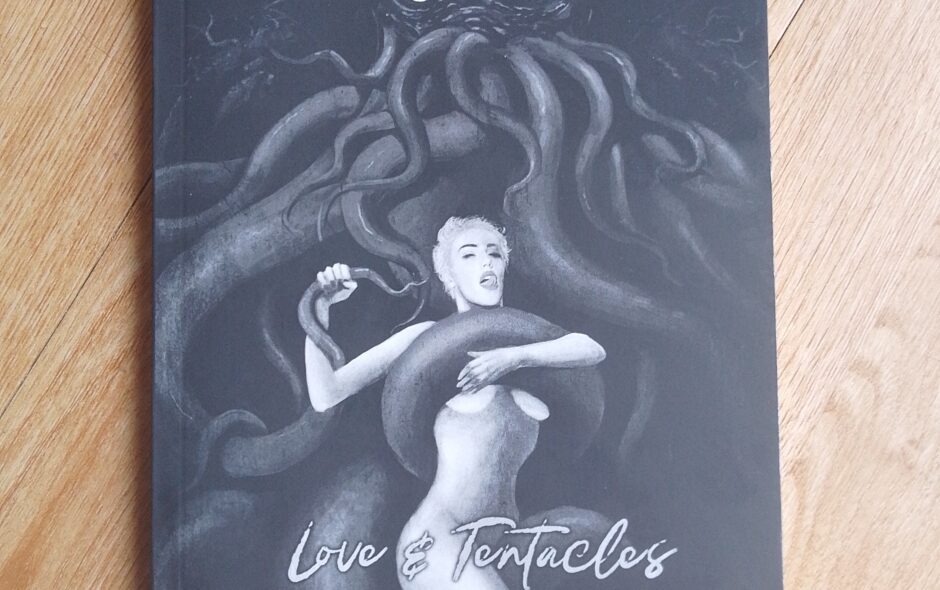
One of my favourite things as a reader is discovering books that turn out to be more than they appear. These books often masquerade as something traditionally defined as “low brow” entertainment, but in truth, they are deeper than their shocking titles or covers would indicate. Madness From The Sea: Cthulhu’s Lure is absolutely one such book. Whilst its hentai cover, depicting a woman pulling an orgasm face as Cthulhu’s tentacles envelope her, would indicate a shallow (though thrilling) bit of smut, Cthulhu’s Lure is so much more than mere tentacle-titillation.

The basic of premise of Cthulhu’s Lure will be familiar to fans of Lovecraft. Frances Smith, a young woman living in Boston, keeps receiving erotically charged dreams about a great squidlike entity that exists in a liminal dreamscape, a haunting “labyrinth of stone monoliths”. Unsure what she is experiencing, she does what most of us in the Twenty-First Century would do, and turns to the internet. It doesn’t take long for Frances to develop a cult following. Some of them are weirdos who are turned on by tentacle fetishes. But many are genuinely curious as to the meaning of her dream experiences.

Meanwhile, Donnie, Frances’ husband, is growing increasingly uneasy with his wife’s behaviour and wants to rescue their marriage. As Frances is drawn closer and closer into the labyrinth of her own desires and fantasies, Donnie—with the help of one of Frances’ friends, Hazel—takes drastic measures to prevent her from hurting herself and others.

There is a lot more to say, but to avoid spoilers, I will leave it there.

One thing I really loved about this story is how it genuinely tried to bring a modern twist to Lovecraft’s original tale. Whilst I enjoy modern Lovecraft fiction, in general I find it too often falls into the trap of trying to re-create the original. Cellphone signal is lost. Maps are destroyed. Time travel occurs. Essentially, the writer tries to avoid modern elements to imitate the same style of horror deployed in Lovecraft’s nineteenth-century stories. Whilst this can be fun for a bit of escapism, it ultimately feels contrived, and like an avoidance of the truth.

Jonathon T. Cross, however, takes on the modern world head on. He explores what a return of Cthulhu might look like in the modern age, and how the internet—a space that operates not unlike a shared dreamworld or an astral plane—would pay a huge part in such a resurgence. Whilst there are comedic moments in the story, overall the modern elements don’t take away from the atmosphere of dread but actually augment it, partly because it is all so believable. You may be looking at me like I’m crazy, but the idea of an internet community building exponentially and then bubbling violently over into the real-world, leaving chaos in their wake, is not only possible but probable in the near future.

Jonathon T. Cross also creates a link between his modern setting and the “old world”. He does this in several ways, but principally through the medium of dream, using the dream-world as a liminal space in which possibilities can coexist, including the communication between entities from beyond the stars and human beings. Whilst dream-sequences can be overused in fiction, the dream-world in Cthulhu’s Lure is a specific and well-used concept that not only serves narrative purpose but also reveals character. Symbolism within the dream is reflected in reality in clever and subtle ways. Likewise, desires expressed in the dream are corrupted and made manifest in the waking world. A dialogue exists between the phantasmal realm of myth and the modern world of crumbling materiality desperately clinging to a sense of meaning. Frances Smith is the middle point where all of this converges: old and new, technological and magical, intuitive and rational, mundane and extraordinary. She is the prophetess of a new age, a red woman sprung from Aleister’s Crowley’s lusty imaginings but instead of being wedded to the Ten Headed Beast she is wedded to Cthulhu.

As I said before, Cthulhu’s Lure is very far from tentacle-porn. In fact, its use of sex bears more in common with Greek mythology than with modern erotica. The concept of a beast or monster mating with a woman to produce theriomorphic offspring is pervasive throughout virtually all the ancient mythologies. Perhaps the most famous example of this is The Minotaur, a creature half-human and half-bull, born of the sexual congress between Pasiphaë and the favoured snow-white bull of Poseidon. Poseidon, of course, is the god of the sea, so there’s already a link, albeit tentative, between Cthulhu and the bull-monster of Greek legend.

Because of the Minotaur’s hybrid nature, Pasiphaë could not nourish the child, and so it became increasingly ferocious and bloodthirsty and eventually turned to devouring human beings for sustenance. The Minotaur is therefore imprisoned in a terrible labyrinth constructed by the genius inventor Daedalus. The Minotaur waits at the heart of the labyrinth, a black secret, devouring any who are sent as offering into its runnels.

Cthulhu likewise waits in the labyrinthine and “sunken” city of R’lyeh, accessible only via dream or by a perilous voyage across the Pacific Ocean. R’lyeh, the labyrinth, these dark and inaccessible spaces represent our unconscious, inhabited by the antediluvian urges that can still be awoken with the right ritual and sacrifice. In the modern world we have seemingly conquered these urges and desires, but we still fear their return, and the time is soon coming “when the stars are right” and these desires—symbolically represented by Cthulhu—will once more walk the earth and hold sway.

The other brilliant thing about Cthulhu’s Lure is that it for all its Lovecraftian and mythological trappings it remains the grounded story of a failed marriage. And despite all the messed up things done by both Donnie and Frances, you still care about both of them, and still sort of want things to work out. Jonathon T. Cross channels Lovecraft, but filters the anxiety, the paranoia, the obsession, and the madness through a totally new lens, producing something that feels like one of the most original takes on the mythos in quite some time.

You can read Cthulhu’s Lure in a single day (I know I did), yet it will take you on a deep journey into a woman’s fracturing psyche and a man’s desperation to save what little he has in life. The last line of the book is a real humdinger. And, I may be wrong, but it looks like there might be further books in the series to look forward to.

Jonathon T. Cross is definitely a writer to watch. You can check out more of his work over at https://www.thatspookybeach.com as well as cool art and other merch.

Blog

Review of Spontaneous Human Combustion by Richard Thomas


Spontaneous Human Combustion is Richard Thomas’s fourth short story collection, featuring 14 tales ranging from cosmic horror, to science fiction, fantasy, and into realms beyond any simple definition. Richard Thomas has a unique style of writing, a trademark syntax that I can spot a mile away, though at the same time he is also chameleon-esque, changing the style and flavour of his prose in order to suit the aesthetics of his story, or to further highlight a theme he is exploring. This is perhaps why he is such an adept of the short story form in particular (though I do adore his novel Disintegration in particular). 

Stephen King describes short stories as “a kiss in the dark” and Richard Thomas exemplifies this transitory (and sometimes transcendental) experience, in which the very brevity of the form becomes the source of its power. We can only connect with the divine momentarily. Yet, to do so can be life-changing. In this way, Richard Thomas’ short stories more closely resemble poems. They do not always operate on the plane of conscious understanding. They are not meant to be comprehended through rational intellect, but to touch something lying beneath that. I found some of the stories in this collection to be moving without really understanding them in full. This collection also took me twice as long as it should have done to read because I was drawn inexorably to re-read virtually every story in the collection (and was rewarded every time with new insight)! 

I am fairly sure that this collection will be divisive in multiple ways. Some people will hate the poetic styling. Some will love it. And beyond this, there is unlikely to be any consensus on what the best story in this collection is. The range on offer here prohibits an easy narrowing down. As I mentioned earlier, Richard Thomas touches on virtually every speculative genre known to humankind, and combines them in often unexpected ways. Secondary world fantasies give way to dystopian science fiction. Lovecraftian horror is mixed with hope-punk. One senses a mind behind all these stories striving relentlessly for originality, to forge something new and not rely on tropes or easy wins. In the extensive and enlightening Endnotes at the back of this collection, Richard Thomas often mentions “challenging himself”, and one can feel that these stories are an almost Barker-esque attempt to discover something beyond the mundane, to “[explore] the further reaches of human experience” (Hellraiser). There is an experimental nature to this which is by definition inexact, but can produce startling alchemy. 

As I have said before, the experience will be highly personal, and no doubt there will be little agreement on which are the most potent stories in this collection, but I will highlight my own personal top four to give you a flavour of the book:

“Ring of Fire”

I would be criminally remiss not to mention this story, as it is the longest in the collection, practically a novella. It was first published in Seven Deadliest Sins, an anthology of seven novelette / novella-length works that centred on the eponymous Seven Deadly Sins, so I had read the story once before (my review of this collection can be found here:https://storgy.com/2019/05/29/book-review-the-seven-deadliest-edited-by-patrick-beltran-and-d-alexander-ward/). “Ring of Fire” is a little bit like a Lynchian Möbius strip, a circle that doesn’t quite complete, a mystery that forever unfolds but never quite solves; at the same time, it’s a tremendous character-arc. It is a slow burner, in which the seemingly explainable and mundane scenes we’re privy too are steadily re-contextualised until we realise that nothing has been “normal” or “explainable” from the start. It is also carries an indescribable sadness to it, as each repetition, each “circuit” of the Möbius, seems to lead us not towards salvation but deeper into the elliptical loops of the psyche. It’s worth mentioning this is not the only story in the collection that involves repeated scenarios or looping narrative. There are several “Groundhog Days” contained in Spontaneous Human Combustion. Some are literal, some spiritual, and others more subtle, but the idea of being stuck in a loop that either cannot be broken, or can only be broken by our most extraordinary efforts—with great sacrifice—is arguably the defining image of the entire collection, and a metaphor for the human condition. 

“The Caged Bird Sings In a Darkness Of Its Own Creation” 

This is another story that I’d read once before; it was first published in Storgy’s Shallow Creek anthology, one of the weirdest and most underrated collections of fiction ever put to print. You can also read my review of that collection here: https://themindflayer.com/review-shallow-creek-storgy/. Richard Thomas’s story is the last story in the collection, and for good reason. It is a total mind-f*ck of chthonic proportions. It centres on Krinkles The Klown, who is a kind of Pennywise for Shallow Creek. But rather than going for shock-horror and killer clown antics, Richard Thomas instead tries to peel back the laters of Krinkles and show us why he is so strange (interestingly, there is another story in Spontaneous Human Combustion about a clown taking off their makeup—I sense a theme emerging!). I do not normally enjoy narratives that leave so much in the reader’s hands, but what I loved about “The Caged Bird Sings In a Darkness Of Its Own Creation” is that Richard Thomas give us a series of choices, and we realise that this is exactly what Krinkles has faced: a series of choices, bargains, and decisions that have led him to the edge of the abyss. The story can be seen as bleak, in some ways, but is this how Krinkles sees it? Richard Thomas shows us that perception is everything in this tale. What we choose to see in the mirror is the reality we inhabit. The story has two strange parallels: Twin Peaks, especially Part 8 of Twin Peaks: The Return (in which the macrocosm of the Lynch-universe is seemingly unveiled); and secondly, Close Encounters Of The Third Kind. In terms of the second comparison, not so much the retro late-seventies vibe, more the contact with something entirely other, and the sense of obsession, panic, and euphoria such contact can bring. 

“Nodus Tollens” 

This story was a huge surprise. It is almost an outlier of the collection, in that it is written in a more prosaic and down-to-earth style. Richard Thomas himself described it as his most “King-like” story, and I would have to agree. As much as I love Richard Thomas’ impressionistic bent, it was refreshing, indeed electrifying, to see him tackle a story in a more grounded way, and as a consequence the story stands out. The title, Nodus Tollens, is a phrase invented by John Koenig on The Dictionary of Obscure Sorrows which means “the realization that the plot of your life doesn’t make sense to you anymore”. Thus, what starts as a simple hand of poker quickly becomes a cosmic game in which sin must be unburdened. 

“Undone”

This story was the biggest surprise in the collection. When I first started reading it, I was uncertain whether I would enjoy it. Essentially, and I don’t think this is not giving away too much, the entire 1,500 word story is written in one sentence. Usually, I would regard this as pretentious; however, Richard Thomas pulls it off, for several reasons, perhaps the most important of which is that the frenetic, relentless nature of the single run-on sentence is used to encapsulate the relentless nature of a terrifying, heart-pounding chase. This clever mimesis justifies the technique and elevates the intensity of the narrative. The plot of the story is simple, or seems to be. Two people are running from something unspeakable. What emerges at the end of the tale, however, is a moment of transcendence, of contact with something ineffable and divine. It is weird, grotesque, beautiful, harrowing, and spiritually uplifting. There are shades of China Miéville here. Never in a million years could I have guessed this would be my favourite story in the collection, but it is. 

Spontaneous Human Combustion is not easy reading (to be fair, in general I do not find collections easy to read due to the stop-start nature of digesting a series of stories); however, it is a rewarding and powerful experience on so many levels. Richard Thomas pushes the envelope of what is possible in fiction, and strives to show us something truly sublime. Perhaps the collection is best summarised in Richard Thomas’s own words from his story “Undone”: “everything I could never be, nothing we have been before”. 

You can pre-order the collection here:

Amazon UK

Amazon US

Blog

The Cathedral of the Deep Part 2: How to Write Gothic

HOW TO WRITE GOTHIC

So, in the previous class we looked at the four key elements of mood, architecture, religion and lyricism. Now, we’re going to put these ideas into practice for writing a short piece of prose. Get ready to do some work!

THE SEED

Exercise 2.1.

Pick a favourite quote from Gothic literature (or any literature so long as the quote itself has Gothic resonance according to the four aspects) or even a film. If you can’t find one or think of one off the top of your head, then you can use this one:

“Despair has its own calms”

– Dracula

Based on this quote, write a short paragraph, expanding on the quote, giving it a modern twist. It doesn’t have to be a whole story, just the beginnings of one. It can be any type of writing response, from philosophical ramblings, a series of images, or a character portrait. Let yourself go.

Exercise 2.2

From the paragraph you’ve written in the previous exercise, you have a basic story premise. By this, I mean you have a seed of something, whether it be an idea, philosophy, or feeling, that can be expanded into narrative form. You will now transform this seed into a five act narrative. The five act structure for storytelling harks back to the Greco-Roman plays of antiquity by such ancient masters as Sophocles and Plautus, but if you want a more recent example, think of Quentin Tarantino’s Kill Bill Vol.1, which is divided into five chapters! As the saying goes: “If it ain’t broke, don’t fix it”. Old forms endure for millennia for a reason. 

The five acts are as follows:

Act I: Inciting Incident

The event that becomes a catalyst for everything that follows, the thing which sets the story in motion.

Act II: Development/Turn the screw

We go deeper into the story here and learn more about why the event happened, possibly learn some new insights about the event and the people involved in it that may cast them in new light or confirm what we initially thought. The tension is amped. I use the phrase “Turn the Screw” in reference to Henry James’ novel The Turn of the Screw, a masterpiece of taut psychological and supernatural horror that continues, each chapter, to “turn the screw”, making things worse, with more at stake, and more horror. 

Act III: Peripitea

This is the moment where our protagonist starts to turn the tables and gain the upper hand in some way, whether that be by realising what they need to do, acquiring an object or ally, or just trying harder. This is a moment where the “good guys” strike back.

Act IV: Anagnorisis

A revelation, some new information comes to light that changes everything. This would be the “I am your father” moment in Empire Strikes Back, or the “I am your mother” moment in Sophocles’ play Oedipus Rex.

Act V: Catharsis

The story reaches its climax and denouement. Something is lost, so that something can be gained. We experience the negative emotions, the suffering, of the protagonist as our own and then are freed from this negative emotion in a moment of sublimity. If this all sounds a bit technical, just think of an ending to a film, book, story, that really moved you at a deep level. This is the catharsis.

Optional Extra: Resolution

Though this is not technically required, most stories have a resolution following the catharsis, a kind of epilogue. This is not a specific act, as it is normally very brief and is disconnected from the central narrative in some way (it takes place years afterwards, or is written from a different perspective). This is the rounding up of things, tying off of loose ends.

EXAMPLE

Let me give you a couple of examples, so you can get the hang on it.

Let’s look at a Gothic/Horror film most of us will have seen (though it’s totally okay if you haven’t): Blade Runner. This has five clear acts.

Act 1, we are introduced to the concept of replicants in that iconic opening scene with Detective Holden interviewing Leon Kowalski. We are also introduced to Deckard (Harrison Ford), eating at a Japanese noodle bar, though not for long, because he is arrested. The first thing we see is a replicant struggling to improvise and imagine, the subtle difference between human and robot, which is tremendously foreshadowing and significant of what will follow. Leon Kowalski’s attack / breakdown is the “inciting incident” that causes Deckard to be summoned to the office to track down the other rogue replicants, led by Roy Batty (Rutger Hauer).

Act 2, Deckard learns about his opponent from his former boss Bryant: Roy and his gang are Nexus-6 replicants, believed to be advanced enough that they may have developed emotions, which might make them harder to detect via VK testing. The scientists designed the Nexus-6s to have only a four-year lifespan. Bryant sends Deckard to Tyrell Corp.’s headquarters to rest the VK machine on a Nexus-6 model. It is here he meets Rachel (Sean Young), a Nexus-6 model so advanced she has memories, and doesn’t know she is a replicant. Meanwhile, Roy, Leon, Pris and other characters forward their schemes, recruiting the “toy maker” Sebastian responsible for much of their code, and gaining equipment needed to enact their plan.

Act 3, is the peripetea, the “turning point”. This is when good gets the upper hand. This is when Deckard uses a number stamp on a snake scale to locate one of Roy Batty’s crew, Zhora, and hunts her down. Deckard tracks down Sebastian and goes to his apartment. As Deckard searches the mess, he is surprised by a disguised Pris, who assaults him using acrobatics. As she performs a series of back flips to finish Deckard off, he shoots her through the abdomen. She spasms violently for a few moments before Deckard shoots her twice more and finally kills her. Many of Roy’s crew have been picked off now.

Act 4, anaganorisis, is the “revelation”. With Blade Runner, this could be a number of things. Roy killing Tyrell whilst muttering the word “father”, to me is a revelation, because it humanises Roy whilst also showing him at his most monstrous. It is proof, if ever it were needed, that the replicants can in fact feel, are human, and even identify the same emotional attachments. Another revelation is during Deckard’s final pursuit and battle with Roy. This is one of the most hotly debated aspects of Blade Runner, which is : Is Deckard a replicant? I believe that the evidence shows Deckard is, himself, a replicant created to hunt replicants. His patchy memory, impulsiveness and childish behaviour, and his callousness (shooting a fleeing and wounded Zhora in the back without hesitation), all serve to support this. But, if final proof were needed, it’s when Roy saves Deckard from falling – gripping his arm and hoisting him up over the ledge. Roy says: “Quite an experience to live in fear, isn’t it? That’s what it is to be a slave.” To me, this indicates that Roy knows Deckard is a “slave”, a robotically programmed replicant like himself. The two are similar, and Roy pities Deckard, which is why he saves him.

Act 5, catharsis. This comes when Roy utters his final speech: “I’ve seen things you wouldn’t believe…” We realise the full extent of his humanity and experience the tragedy of mortality, the frailty of human life, and how fleeting experience truly is: “…lost… like tears in rain”. This is where we feel the pain, sorrow and suffering and then are released from it.

Resolution: Deckard and Rachel flee together.

BACK TO THE EXERCISE

Write a plan for your story. This can be as detailed as you like but should start as just five bullet points conforming to the above. Read and reread your structure, keep adding detail, until your are satisfied that this will be a story that hits home.

We now have the basic five act structure for your story, the “bones” of the piece. We will go on to look at these story bones in more detail, cloaking them in flesh.

HOW TO WRITE YOUR OPENING

Now, you will write an opening for the story you just planned out! We’re going to look at the first 1 – 3 paragraphs only, as these are so critical. We will look in detail at opening lines, how they work, what you need to be doing to make it gripping and in keeping with Gothic.

Writing a Gothic story opening is very different to writing the opening to another novel. If you look at Crime novels, for example, the work of someone like Lee Child or Jodi Piccoult, all their openings follow a very strict formula, almost like a screenplay.

They introduce a character, an action, a place, and a time. And, they have a hook, something we want to know. Or, at least, something intriguing or out-of-sync or unusual. In strict structures, the hook must tie in with the climax of the story.

Every time its the same formula. Gothic is a little more experimental precisely because of the lyrical element, the poetic nature of the genre. Gothic can be more suggestive or symbolic in the way it handles it opening. Let’s look at some examples.

This is the opening of Mark Shelley’s Frankenstein.

‘I am by birth a Genevese, and my family is one of the most distinguished of that republic. My ancestors had been for many years counsellors and syndics, and my father had filled several public situations with honour and reputation. He was respected by all who knew him for his integrity and indefatigable attention to public business. He passed his younger days perpetually occupied by the affairs of his country; a variety of circumstances had prevented his marrying early, nor was it until the decline of life that he became a husband and the father of a family.’

If I’m honest, I don’t really like this opening. It’s fairly dull and obsequious, which I guess is due to the character’s voice – but it doesn’t help grabbing my attention. However, this opening is here to create verisimilitude. We are meant to believe this manuscript we hold in our hands really is the journal of a Genevese aristocrat, who has an astonishing encounter in icy wastes with Victor Frankenstein. This was not in the original draft of the novel, however. Originally, Mark Shelley opened the novel at Chapter 5:

‘It was on a dreary night of November that I beheld the accomplishment of my toils. With an anxiety that almost amounted to agony, collected the instruments of life around me, that I might infuse a spark of being into the lifeless thing that lay at my feet. It was already one in the morning; the rain pattered dismally against the panes, and my candle was nearly burnt out, when, by the glimmer of the half-extinguished light, I saw the dull yellow eye of the creature open; it breathed hard, and a convulsive motion agitated its limbs.’

This is exemplary Gothic. It is poetic, visually intense, and dark as night. The language is elevated, which suits the voice of a mad genius, and the importance of the event – the creation of life. There is tremendous mood and atmosphere here, created with the wonderful details. This, to me, is where the story should have begun, and shows Shelley’s true talent.

Let’s look at the opening of something more recent, like Haruki Murakami’s After Dark:

‘Eyes mark the shape of the city. Through the eyes of a high-flying night bird, we take in the scene from midair. In our broad sweep, the city looks like a single gigantic creature – or more like a single collective entity created by many intertwining organisms. Countless arteries stretch to the ends of its elusive body, circulating a continuous supply of fresh blood cells, sending out new data and collecting the old, sending out new consumables and collecting the old, sending out new contradictions and collecting the old. To the rhythm of its pulsing, all parts of the body flicker and flare up and squirm. Midnight is approaching, and while the peak of activity has passed, the basal metabolism that maintains life continues undiminished…’

So here, we don’t even have a character (unless it’s the ‘night bird’) or an action (unless it’s the ‘sweep’), but we do get a strong sense of place, time and, all-importantly, mood. We also have lots of questions. Why is it significant that ‘midnight is approaching’? Why is the city so vividly described? Could it be that the city itself is a character in this novel? The imagery is also quite disturbing and Lovecraftian: this colossal monstrous creature emerging. It’s very Gothic.

FIRST LINES

In Gothic style, the game is saying what you want to say symbolically, so, try to set up your story indirectly. In After Dark, it’s by creating this ominous foreboding of the city as a body. The fact the ‘basal metabolism’ is keeping the city alive is also foreshadowing of the character Eri who is locked in a coma, unable to wake up.

Let’s look at the opening of The Turn of the Screw by Henry James:

‘The story had held us, round the fire, sufficiently breathless, but except the obvious remark that it was gruesome, as on Christmas Eve in an old house a strange tale should essentially be, I remember no comment uttered until somebody happened to note it as the only case he had met in which such a visitation had fallen on a child.’

Long sentence, but it touches all the bases of openings: character, action, mood, place, time. It is very self aware: its a ghost story about people telling ghost stories around a campfire. The hook is the reference to the child at the end. We know this story is going to be very disturbing because of this. It’s also evasive. There aren’t particulars about what was gruesome about the story or what, exactly, the ‘visitation’ was.

Exercise 3.

Let’s write an opening using these above points as a reference. We’ll start with the first line. Your first line needs to hit hard and stand alone. Arguably, like the first shot of a movie, it should encapsulate the entirety of the meaning of your story. While this sounds impossible and ambitious, it is more a guideline, a good thing to aim for.

Have a go at writing your first line now! Read it back, does it touch on some of the above requirements of character, action, mood, place, time and one or two of the Gothic elements of mood, architecture, religion or lyricism? Can it be improved or shortened? Does it hook?

There is an old saying: “Sweat your fist line”. It’s one of the most important aspects of your story. Think of how much store you put in “first impressions” in life. This is your first impression!

First Paragraph

After your first line, you need to broaden out more. This is where your second hook should come, another reason to read on.

Exercise 4.

Write a paragraph following on from your first line. Explore what’s going on, deepen the symbolism, or perhaps pull back and offer clarity. Go on to give more information but do not overload your reader with data. Allow the story to emerge naturally. Your reader is always smarter than you think. You need to give them further reasons to read on too.

Henry James’ really long first line works as both a first line but also a first line and paragraph. The first segment: ‘The story had held us’ works like a stand-alone line. In fact, it would be more grammatically correct if there was a full-stop there.

So, a snappy first line that stands alone, and has some kind of greater resonance. Then, a first paragraph that draws us in to the narrative that will follow. Try giving it a go, then share it with friends/family/someone you trust, and see what they think. Do they want to read on?

From here, you can start building your story piece by piece, in accordance with the five act structure. I would go into detail of how to write your ending, but there is too much to say about writing a Gothic ending (or indeed any story ending) to include it here. If you liked this article, and feel you would like more – including about writing a good ending – please do leave me a comment, or message me on Twitter, and if enough people are interested I will write a Gothic article about endings.

Well, time for me to leave you on a favourite quote:

“The curse of life is the curse of want. And so, you peer… into the fog, in hope of answers.”

– Dark Souls II

X

Thank you so much for coming this far. I hope that this class has been of use to you. We’ve now reached the end of Part 2, and the class has a whole. I really enjoyed writing up these notes from my seminar, and I hope they are of use to you in some way. Thanks very much for taking the time to read it, it means a lot to me.

If you feel that you have benefited from today’s class, then please check out my KoFi page, where you can donate $3 to “buy me a coffee” to help me keep producing free resources like this. Do not feel pressure to do so, but small contributions can go a long way for creators like me.

Until next time, my friends!