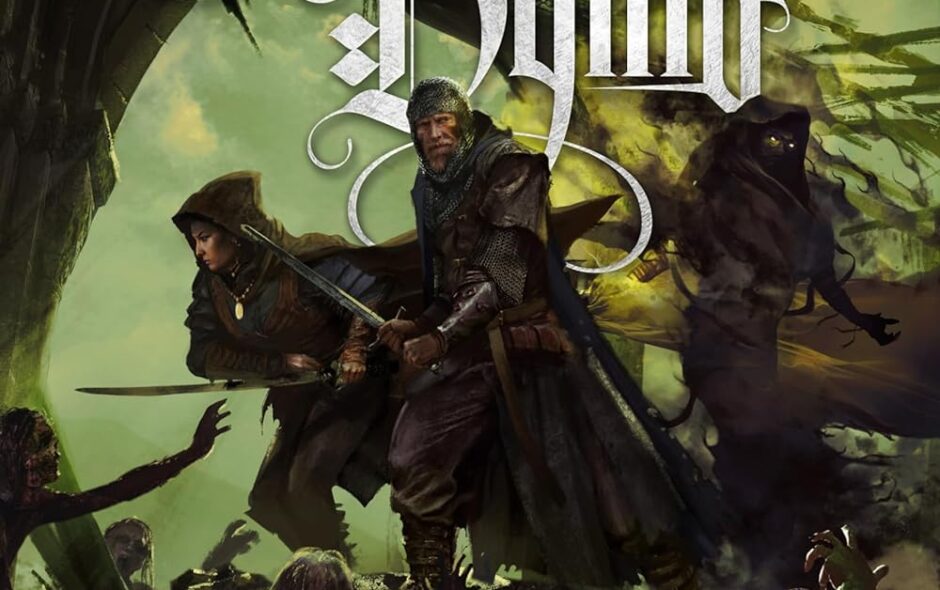
Very few writers can claim to have not only coined the term for a new, emergent genre but also produced an exemplar of the form. However, Daniel J. Volpe is one such writer. In voicing the words “Splatter-Fantasy”, Volpe has opened the doors to a whole new realm of fantasy literature with a dark edge, as well as recategorising many extant works that previously eluded easy attempts at definition.
While Grimdark has been around for a while—indeed, Volpe cites a few masters of Grimdark in his dedications, such as Abercrombie—it tends to focus on blood, politics, and betrayal. There’s plenty of that in A Story of Sorrow. But there’s also something else, something undeniably weird. The closest parallel to what Volpe is doing in A Story of Sorrow is the baroque masterpiece BleakWarrior, a novel described as “Sword & Debauchery” but which fits into the new paradigm of Splatter-Fantasy. What sets these books apart from Grimdark or standard Dark Fantasy works is their ability to incorporate horror into the fantastical and magical elements, to unflinchingly pursue their inquiry into the dark side of existence even into realms beyond the real.
However, as fascinated as I am by this new genre, I don’t want to get sidetracked and neglect to talk about A Story of Sorrow itself.
A Story of Sorrow is a Robert E. Howard-esque episodic series (at the time of writing, there are three entries) that captures the magic of watching old fantasy television programmes such as Xena, Warrior Princess, only Volpe’s world and characters are a good deal darker than even Xena’s blackest adventures. The books are short and sweet (whichagain makes them feel like an hour-long television special, rather than a two or three hour film). And each one is self-contained, though of course if you do read the books in order, a deeper and darker plot begins to emerge, tying together the narrative threads woven through each book.

I had such a good time with this series. Simply put, A Story of Sorrow is so much fun, the most fun I have had with a fantasy series in a good long while. Rather than bogging himself down in world-building and magic systems, Volpe understands that it’s the characters who make a great tale.
Enter our hero, the aptly named Sorrow, a former gladiatorial blade-master turned galley-slave. We first meet Sorrow in book 1, Of Flesh and Blood, chained to the oars of a ship being torn apart by a black storm. I knew I would like him when he turns to Hame, one of the slavers who has just lashed him, and remarks, “You would strike a man when he wasn’t looking, but I already knew that… then again, you’re a cunt.” These are Sorrow’s first lines of dialogue. Character established.
The opening sequence sets the tone of the entire series, as the slave-masters desperately try to whip the galley-slaves into saving the sinking ship, and the divine hand of providence wreaks untold fury upon them. Only the strongest wills survive. The rest become “gull shit”.
From there, we meet a cast of horrible but lovable (and perhaps lovable because they are so horrible) side characters: Jagrim, an axe-wielding mercenary with a taste for whores and rot-gut. Gortul, another mercenary, a little more grounded than Jagrim, but just as deadly with his mace. Then there’s the sneaky, slip of a boy, Finleos, who looks a little bit too similar to Sorrow for comfort... And, a personal favourite: Zakkas, who comes from the Land of Burning Sands, wields a scimitar, and is forever taking the piss out of his pale-skinned companions. It’s a classic fantasy set-up of “men on mission”, with lots of crude banter and insults and violent killing, but it’s done with pathos, humour, and heart. You sense that despite the brutality of this world—or perhaps because of it—Volpe cares about his characters and what they are going through, and he makes you care about them too.
And, often times, just when we think we have the measure of a character, Volpe turns matters on their head. A good example of this is Vicar Prentas in the first book. We spend most of the book hating the officious idiot, viewing him through Sorrow’s admittedly biased lens—he has no love of the Church—but at the end of the story information comes to light that changes the way we perceive Prentas and makes us question Sorrow’s unbridled criticism of the Church. Likewise, we grow fond of certain characters, only for them to commit heinous acts that makes us question how far we can sympathise with them. This makes the characters feel alive.

Despite my saying Volpe doesn’t bog us down with world-building, there is a really fascinating world here. Volpe doesn’t try to reveal all of it in one go—a classic error many fantasy writers make—but instead gradually unveils its politics, its religious divides, its magic, and its cities and territories. It’s world full of ruthless cut-throats, seedy taverns, whorehouses where the odds of ending up dead or plague-ridden by the end of the night are extremely high, black magic rites, and fights to the death either for vendetta or amusement. It’s also a world full of mysterious creatures that are just left of the predictable fantasy tropes. In the second book, for example, our antiheroes find themselves being hunted in the mountains by a horrific six-eyed monster awoken in the bowels of a cave. The creature is so old and so nightmarish that it is never even given a name. No one knows what the hell it is, which makes it five times scarier.
The final two things I would like to say about the series are this. Firstly, Volpe really understands the concept of “pay off”. He places a Chekhov’s Guns on the table in his openings, and invariably they fire in the second half of the book in interesting ways. Sometimes, you can see how the plots are going to dovetail, but that isn’t a criticism—the plot becomes inevitable, which gives it riptide power to pull you on, turning pages without breathing. I found myself in awe of the way that certain narratives would converge in order to advance the story, and even more awed when the outcome was not what I expected.
Secondly, Volpe really has a gift for prose. His prose is precise and fluid and—perhaps because he is a horror writer—he has this knack for making certain images suddenly jump out at you. No book is perfect, of course, and there were one or two small anachronisms that threw me out of the fantasy world (I am sorry, but I am a stickler for things like this!). However, these hardly matter when paired with sentences as evocative and gorgeous as this opening line to book 1:
“It rode into town on the back of a dead horse, wearing a cloak of human flesh.”
Or, this throat-constricting scene from the opening of book 2:
“She clawed, trying to reach his face with her long, dirty nails. Fesha hooked a chain around his neck, pulling forth a shimmering amulet from his shirt. The metal was mirrored finish and, in its reflection, Fesha glimpsed fear in her eyes. It was the last thing she’d ever see.”
Overall, A Story of Sorrow is a really unique approach to writing fantasy—combining old school sword and sorcery with twisted, gut-wrenching horror and delivering it in a slim, episodic format. I found myself totally immersed in the tale and sad when I had finished the third book that there was no more (and also sad because the ending of book 3 is horrific and I mean that in a good way). Here’s hoping that Volpe releases book 4 soon. Until then, I’ll be killing time drinking gut-rot in the taverns of Ayr.
You can find out more information, or purchase copies, of A Story of Sorrow here: