Blog

Review of There’s Something Here From Somewhere Else by Jonathon T. Cross

Sometimes, a title just reaches out and grabs me—and I have to buy the book. This was the case with There’s Something Here From Somewhere Else. It’s a perfect encapsulation of cosmic horror’s foundations: a fear of the Other, of what’s Out There.

These themes are woven through this cosmic horror novella. Jonathon T. Cross is clearly a fan of classic Lovecraftian fiction, and There’s Something Here From Somewhere Else reads like it could have been penned by Lovecraft. Whereas Jonathon T. Cross’s other cosmic horror story, Cthulhu’s Lure (which I reviewed here), is set in the modern day and reimagines the mythos through the lens of internet cults and modern celebrity, There’s Something Here From Somewhere Else is more straightforward and old school. Set in the 1950s, the story centres around a girl called Lydia whose family have recently moved to a village in the swamp. Local legends surround the place about a creature known as The Lurker. Herbalism and witchcraft are rife here. Law enforcement exists, but the town seems to prefer its own brand of lynch-mob justice. Lydia hates it here, and it’s easy to see why.

The swamp is a perfect backdrop for a tale of cosmic terror. There are very real monsters in the swamp—gators, as one example—and the people there have been hardened by their difficult existence.

But just when Lydia’s life seems to become unbearable, a doll appears. The doll looks just like her, like it was made for her. The doll brings her comfort. The doll might just have otherworldly powers…

What enfolds is a story that centres around perception. Where Jonathon T. Cross diverts from Lovecraft is his interest in perspective and truth. Lovecraft’s protagonists are almost invariably scientifically minded individuals—or fully fledged scientists—who inch closer and closer to the truth by means of their scientific methodology. The truth invariably destroys them. Lovecraft’s imagery speaks to an underlying obsession in the unconscious mind of the human race. Lovecraft described it as “fear of the unknown” but in actual fact his fiction exposes that far from it being unknown we already know this truth and will do everything in our power to avoid confronting it. When forced to face it, we are utterly destroyed.

Jonathon T. Cross, on the other hand, presents a more muddied picture of truth (again, the swamp forms the perfect symbolic backdrop for this!). The muddying of truth is woven into every facet of the narrative. Lydia’s parents are not who they say they are. The mysterious witch who lives “out in the fog” and keeps a pet wolf is not who everyone thinks she is. Lydia’s rescuers are not who they say they are. Lydia herself is not who she thinks she is. The whole narrative we are reading is not what we think it is.

The fear in the story doesn’t really come from The Lurker, so much as the instability and deceits of the human mind. When we cannot rely on our eyes to truly see or our ears to truly hear, then who is to say we do not live in a world of horrors. The recurring motif of There’s Something Here From Somewhere Else is safety found and then taken away again. There is no harbour, no port in the storm. That is because the sickness lies within. The horror—the cosmic invasion—has occurred at a psychological level, where we cannot even run from it.

If I have one criticism of the novella, it’s that at times the narrative relied on “telling” rather than “showing”. Conversations, for example, were often delivered in blocks of narrative prose rather than letting us hear the actual dialogue. Given the themes of the story, this works slightly against the book. Having said that, the story is still atmospheric, intriguing, and pulls off a great denouement.

Jonathon T. Cross is establishing himself rapidly as a fine purveyor of cosmic horror fiction that respects the tradition but also adapts it; his work merits a great deal more attention.

You can purchase There’s Something Here From Somewhere Else on Amazon:
Amazon UK

Amazon US

Amazon CA

Blog

Review of Madness From The Sea: Cthulhu’s Lure by Jonathon T. Cross

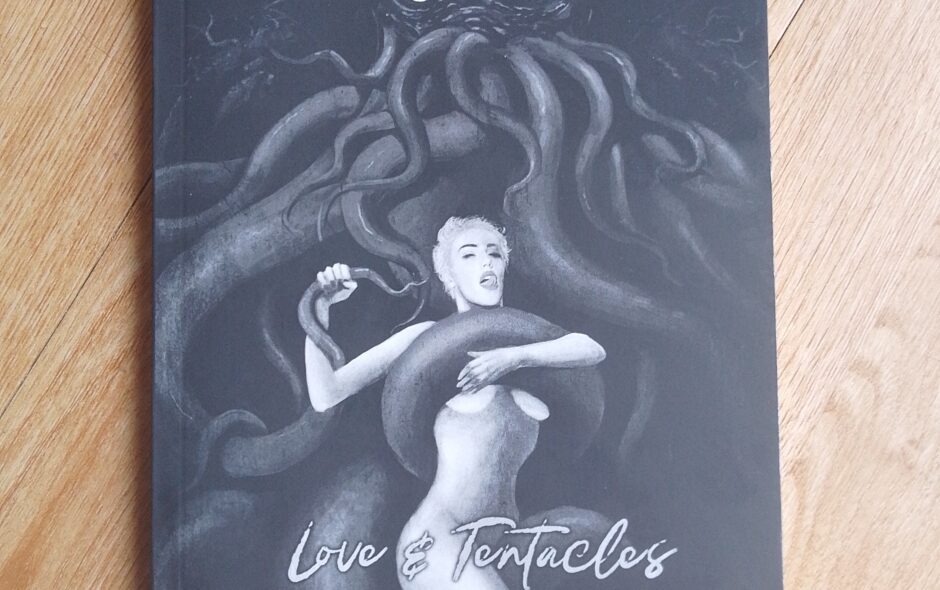
One of my favourite things as a reader is discovering books that turn out to be more than they appear. These books often masquerade as something traditionally defined as “low brow” entertainment, but in truth, they are deeper than their shocking titles or covers would indicate. Madness From The Sea: Cthulhu’s Lure is absolutely one such book. Whilst its hentai cover, depicting a woman pulling an orgasm face as Cthulhu’s tentacles envelope her, would indicate a shallow (though thrilling) bit of smut, Cthulhu’s Lure is so much more than mere tentacle-titillation.

The basic of premise of Cthulhu’s Lure will be familiar to fans of Lovecraft. Frances Smith, a young woman living in Boston, keeps receiving erotically charged dreams about a great squidlike entity that exists in a liminal dreamscape, a haunting “labyrinth of stone monoliths”. Unsure what she is experiencing, she does what most of us in the Twenty-First Century would do, and turns to the internet. It doesn’t take long for Frances to develop a cult following. Some of them are weirdos who are turned on by tentacle fetishes. But many are genuinely curious as to the meaning of her dream experiences.

Meanwhile, Donnie, Frances’ husband, is growing increasingly uneasy with his wife’s behaviour and wants to rescue their marriage. As Frances is drawn closer and closer into the labyrinth of her own desires and fantasies, Donnie—with the help of one of Frances’ friends, Hazel—takes drastic measures to prevent her from hurting herself and others.

There is a lot more to say, but to avoid spoilers, I will leave it there.

One thing I really loved about this story is how it genuinely tried to bring a modern twist to Lovecraft’s original tale. Whilst I enjoy modern Lovecraft fiction, in general I find it too often falls into the trap of trying to re-create the original. Cellphone signal is lost. Maps are destroyed. Time travel occurs. Essentially, the writer tries to avoid modern elements to imitate the same style of horror deployed in Lovecraft’s nineteenth-century stories. Whilst this can be fun for a bit of escapism, it ultimately feels contrived, and like an avoidance of the truth.

Jonathon T. Cross, however, takes on the modern world head on. He explores what a return of Cthulhu might look like in the modern age, and how the internet—a space that operates not unlike a shared dreamworld or an astral plane—would pay a huge part in such a resurgence. Whilst there are comedic moments in the story, overall the modern elements don’t take away from the atmosphere of dread but actually augment it, partly because it is all so believable. You may be looking at me like I’m crazy, but the idea of an internet community building exponentially and then bubbling violently over into the real-world, leaving chaos in their wake, is not only possible but probable in the near future.

Jonathon T. Cross also creates a link between his modern setting and the “old world”. He does this in several ways, but principally through the medium of dream, using the dream-world as a liminal space in which possibilities can coexist, including the communication between entities from beyond the stars and human beings. Whilst dream-sequences can be overused in fiction, the dream-world in Cthulhu’s Lure is a specific and well-used concept that not only serves narrative purpose but also reveals character. Symbolism within the dream is reflected in reality in clever and subtle ways. Likewise, desires expressed in the dream are corrupted and made manifest in the waking world. A dialogue exists between the phantasmal realm of myth and the modern world of crumbling materiality desperately clinging to a sense of meaning. Frances Smith is the middle point where all of this converges: old and new, technological and magical, intuitive and rational, mundane and extraordinary. She is the prophetess of a new age, a red woman sprung from Aleister’s Crowley’s lusty imaginings but instead of being wedded to the Ten Headed Beast she is wedded to Cthulhu.

As I said before, Cthulhu’s Lure is very far from tentacle-porn. In fact, its use of sex bears more in common with Greek mythology than with modern erotica. The concept of a beast or monster mating with a woman to produce theriomorphic offspring is pervasive throughout virtually all the ancient mythologies. Perhaps the most famous example of this is The Minotaur, a creature half-human and half-bull, born of the sexual congress between Pasiphaë and the favoured snow-white bull of Poseidon. Poseidon, of course, is the god of the sea, so there’s already a link, albeit tentative, between Cthulhu and the bull-monster of Greek legend.

Because of the Minotaur’s hybrid nature, Pasiphaë could not nourish the child, and so it became increasingly ferocious and bloodthirsty and eventually turned to devouring human beings for sustenance. The Minotaur is therefore imprisoned in a terrible labyrinth constructed by the genius inventor Daedalus. The Minotaur waits at the heart of the labyrinth, a black secret, devouring any who are sent as offering into its runnels.

Cthulhu likewise waits in the labyrinthine and “sunken” city of R’lyeh, accessible only via dream or by a perilous voyage across the Pacific Ocean. R’lyeh, the labyrinth, these dark and inaccessible spaces represent our unconscious, inhabited by the antediluvian urges that can still be awoken with the right ritual and sacrifice. In the modern world we have seemingly conquered these urges and desires, but we still fear their return, and the time is soon coming “when the stars are right” and these desires—symbolically represented by Cthulhu—will once more walk the earth and hold sway.

The other brilliant thing about Cthulhu’s Lure is that it for all its Lovecraftian and mythological trappings it remains the grounded story of a failed marriage. And despite all the messed up things done by both Donnie and Frances, you still care about both of them, and still sort of want things to work out. Jonathon T. Cross channels Lovecraft, but filters the anxiety, the paranoia, the obsession, and the madness through a totally new lens, producing something that feels like one of the most original takes on the mythos in quite some time.

You can read Cthulhu’s Lure in a single day (I know I did), yet it will take you on a deep journey into a woman’s fracturing psyche and a man’s desperation to save what little he has in life. The last line of the book is a real humdinger. And, I may be wrong, but it looks like there might be further books in the series to look forward to.

Jonathon T. Cross is definitely a writer to watch. You can check out more of his work over at https://www.thatspookybeach.com as well as cool art and other merch.

Blog

Review of Nikki Noir’s Black Planet

A new extreme horror author has exploded onto the scene, and her name is Nikki Noir. I first encountered Nikki Noir via her non-fiction work. I found her essays over at Redrum Reviews, reflecting on horror and its cultural significance, extremely illuminating. I then went on to read a novella / short novel Noir had collaboratively written with S. C. Mendes. I am a huge fan of S. C. Mendes, as he wrote the conspiracy theorist’s wet dream: The City, a detective novel that involves a secret city, lying just beneath the world we know. Their collaboration, Algorithm Of The Gods, was like The Matrix mixed with a grim-dark universe. It probed human psychological depths through the mechanism of virtual reality (a subject which is very close to my heart). It was a complete slam dunk, faulted only by not being longer! At the back of Algorithm Of The Gods, Noir included an extract from her ongoing series Black Planet. After reading merely a few pages, I knew I had to read the entire thing.

Black Planet is currently a four-part series, although it’s clear that Noir intends to write more. You can get all four existing volumes together in a gorgeous paperback edition here.

Black Planet is not a book for the faint of heart: it features black magic, gruesome sex rites, and cosmic horror. There is a lot going on in these four volumes, but to attempt a rough summary: forces, perhaps from another dimension, arrive within the small American town of Shale, Arizona. These forces begin to worm their way into the population. Whilst the immediate temptation would be to draw comparisons with something like Invasion of the Body Snatchers, I actually think it has a little bit more of the flavour of The Shining; there are profoundly dark powers at work, and they begin to affect everyone within their reach. Some are more easily influenced than others, and they become the instruments of these powers.

What particularly intrigued me about the book were its Thelemic influences: the magick (with an intentional ‘k’) of Aleister Crowley, Kenneth Grant, and other such mystics. Noir deftly utilises these influences to create a sense of something awful and beyond understanding, but without falling into the trap many occult writers fall victim to of lacing their work with impenetrable and aloof symbolism. She tells a compelling yarn of human addiction and desire, in which characters feel (arguably rightfully) wronged by the modern world, and have resorted to dark paths to success and freedom from their current state. This is embodied in the opening volume (“Corpse Paint and Rabbit Hole”) in which a disillusioned webcam model, Claire, and her boyfriend slash “manager”, Brian, are sucked into the whirlpool ofnecromantic arts. Noir perfectly encapsulates the feeling of spiritual and physical awakening in a hair-raising sexual encounter in the midst of a violent storm, in which the transcendental experience of an orgasm amidst rains of lightning becomes emblematic of something else.

But despite the fact there is a lot of sex in Black Planet, Noir isn’t writing just to titillate us. More often than not, strikingly erotic scenes are suddenly undercut by intense horror. One teenager’s sexual fantasy suddenly becomes a process of bodily invasion – where the penetrator becomes the penetratee. This is reminiscent of the harrowing descriptions in Jack Parson’s Book of the Antichrist in which he finds punishment for his hubristic pursuit of the magical arts at the hand of demonic entities. Noir is playing a dark and delicious game with us, showing how easily we might be allured by our fantasies – to use a crude phrase: led by the dick – only for her to then turn it on us, which is, of course, the universal testimony of anyone who has dabbled with the dark arts, or drugs for that matter. First, all seems wonderful. Then cometh the fall. 

Each volume of this four-parter has a slightly different flavour. There are characters who run throughout the entire story, but we see less or more of them depending on the focus of a particular volume. This creates quite an unsettling and unconventional narrative experience. At times I felt like perhaps the net had been cast too wide, and I wanted Noir to focus more on a tighter cast of characters – but she also managed to pull off some incredible plot dovetails that were very satisfactory. In addition, characters whom I had very little interest in at one stage, suddenly developed and became fascinating later on. She practices “less is more”, and knows that readers need space to flesh out characters with their own imaginative fuel. Noir doesn’t overprescribe them. 

Amidst all the darkness, however, there is also innocence, and one of the most moving aspects of the novel is the fact that this innocence can be preserved, even where there is trauma and violation. Haley and Tyler are two siblings, good kids, who have to endure the maelstrom that is steadily enveloping Shale. They only really have each other. Throughout the novel we see both of them go through hell, and a good deal of character development. Haley moves from someone who is uncertain about her future, to someone who will do whatever it takes to protect her brother, and her evolving resourcefulness is well depicted. She doesn’t jump from frightened girl to Sigourney Weaver overnight, but we see the steady progression and how each new experience transforms her attitude to the world. This kind of character development is hard to achieve, and in a novel with this many moving parts, even more so; Noir is to be commended for this triumphant effort. 

Lastly, Black Planet has an ending, but it’s clear it’s not the ending, and we’ll be following Tyler and Haley again some time in the future. Anyone who has read my work will know I’m very big on endings, and whilst I’ve no qualms with a slightly open-ended approach, especially where there is clearly more story to be told, I would be interested to see Noir tackle a more “final” and conclusive ending in subsequent books or future volumes of Black Planet itself. That said, this is perhaps my own personal preference, and nothing more. 

If you’re looking for extreme horror (and it really is extreme folks), something dark that deals with what lies just beyond our civilised sphere, then I cannot recommend picking up Black Planet enough. Nikki Noir has immense writing talent, and I cannot wait to see what she does next. 


If you enjoyed this review of this occult horror novel, then appropriately you can sign can sign up to the Mind-Vault as either a “Thrall” or “Cultist”, and get access to tons more content (as well as helping me to finance radical stuff). Your Mindflayer overlord compels you…

Become a Patron!