Blog

Two Myths of the Modern World

Where there are human beings, there are myths. Myths surround us and permeate everything we do. Where we least suspect myths, they breed in greatest abundance. Science, for example, claims empirical and objective truth, but we know full well this is merely another narrative, another perspective, another myth retold in modern form; in this case, it is the myth of the great sorcerer equipped with talismans of “clearsight”, the wizard who subdues nature by virtue of knowledge.

Without myths, our lives would not only be dull, but we would also struggle to see our place in the universe. For better or worse, we are bound to our mythic narratives. They shape us.

Ted Hughes believed that at moments of crisis, “shamans” arise to give voice to the myth of their present time, to lead people through the darkness of uncertainty—perhaps when the old established myths have been too challenged and changed to be recognisable anymore. The prime example he gives is that of Shakespeare in the Elizabethan period. Shakespeare emerged at a moment of profound crisis of identity, where the twin polarities of Protestantism and Catholicism—held at bay only by the sheer force of Queen Elizabeth I’s personality—threatened to obliterate not only each other but Britain as a whole. Shakespeare’s first long-form narrative poem, Venus and Adonis, described the myth of his time—one of loss of soul, of transformation, and a Virginal Goddess—and in some sense rallied the British people to confront their own mythic crisis.

Venus & Adonis by Titian

But what are the myths of our time?

In my opinion, our time is defined by two myths that are at once distinct and deeply interlinked. The first of these myths is The Voyage Home.

The journey home features heavily in mythic narratives. Jung would no doubt have a lot to say about this ever-present desire in our psyche. The Voyage Home reflects not merely a physical journey but also a spiritual and temporal one, for home is often located in the past, in a Golden Age of innocence that has to be found again.

The Odyssey, of course, is the prime and enduring example of this myth. The hero, Odysseus, having fought for ten years at Troy, must now get home to Ithaca, to his son Telemachos and his wife Penelope, the latter of which may be a metaphor for his own soul. But he is waylaid, transformed, and, when he finally arrives home, is almost unrecognisable. But this change proves good, for his pride has at last been humbled. His reunion with Penelope is all the sweeter for his travails.

It seems no coincidence that a slew of film adaptations of The Odyssey have emerged in recent years: The Return, starring Ralph Fiennes, and Christopher Nolan’s forthcoming movie spring immediately to mind.

But there have been other more radical takes on this mythic narrative, and I believe one in particular might be considered our very own Shakespearean, shamanic iteration—the supreme rendering of the myth for our time. I’m speaking, of course, of David Lynch’s Twin Peaks: The Return.

A direct reference to the myth of Orpheus is present in "Twin Peaks: The Return", because Dale Cooper looks back at his Eurydice, and thus condemns her to oblivion.

Twin Peaks: The Return is, as its name suggests, all about coming home, about returning to a past Golden Age that has been somehow lost or corrupted. Like The Odyssey, Twin Peaks: The Return takes us on a voyage in which our hero and his crew are beset by monsters—doppelgangers in particular—and trials. These tribulations are physical, emotional, and spiritual all at once. But unlike The Odyssey, the tragedy of Twin Peaks: The Return is that in the end it is not possible to find our way home. Lynch’s beautiful but also terrifyingly nightmarish vision is one that exposes perhaps the primary fear of our time: that things are only going to get worse (we might meditate on the title of the best-selling book by Eric Larocca, Things Have Gotten Worse Since We Last Spoke, as a kind of emblematic catchphrase of our time).

Twin Peaks: The Return is about many forms of voyage home: a return to the town of Twin Peaks which represents an idyllic country America, a home that perhaps no longer exists; Dale Cooper’s return to reality, and his own body (another home), after years trapped in the Red Room; and, in the meta sense, the return of an old ‘90s TV show to television (the home where it belongs). Lynch, however, never relies on meta as a way out of meaning. His films work similarly to Shakespeare's plays in that they operate on multiple levels. They are self-aware but not to the extent that they are empty, just enough to remind us that “We live inside a dream” and “All the world’s a stage.”

Through the 18-part series, the increasing isolationism of the modern world is laid bare. Our heroes are those who try to keep the connection alive, but the price of lacking that connection is all-too-apparent. The series is at once a longing for a past time before the Fall—which Lynch seemingly locates in a black and white 1950s—and an Orphean warning of the perils of looking back, lest we not only lose the past but also destroy the future. Its final image is one of total confusion, despair, and uncertainty, in which our heroine Laura Palmer—the lost Penelope—can only scream.

The final image of "Twin Peaks: The Return", a harrowing yet strangely rousing scream, a scream, perhaps, to shake us from sleep.

While it may sound harrowing and negative, Lynch sincerely believed in the power of love. But he would not let that optimistic belief soften his warning to the world. Twin Peaks: The Return was Lynch’s last fully-fledged cinematic gift, an astonishing opus designed to shake its viewers out of the sleep into which they have been lulled by the forces of darkness. We must be grateful to him for it.

The second myth that defines our time is The Old Gods Returning.

The Returning King or God is a powerful myth that has existed seemingly since the dawn of time and will likely continue to exist until the ending of the world. It has found potent iterations in the myth of Osiris and King Arthur—the latter of which is still very much alive today in Glastonbury! Though echoed time and again across many cultures, the most powerful expression of this myth is almost undoubtedly the Christian story.

But what I now see emerging is a new variation on that myth. There has, in recent years, been a resurgence of Paganism. The Norse and Greek gods in particular seem to be finding currency again: in popular literature, movies, television series, as well as occult circles, New Age thought, and beyond.

A particularly striking example of this Pagan resurgence can be found in the film Mandy by Panos Cosmatos. In Mandy, Nicholas Cage plays the role of Red, who we slowly realise throughout the film is likely not human, but in fact a god living out a quasi-mortal life with the woman he loves (as the Greek gods were often want to do). He is described as “A Jovan warrior from the eye of the storm” (a line of pure poetry if ever there was one). Throughout, Red draws comparisons with Jupiter—not just the planet, of course, but also the Roman deity, the equivalent of the Greek Zeus. In one startling scene, Red sets a Christian church on fire to utterly destroy a hive of evil Christian evangelicals.

Christianity burns in "Mandy" as the old gods return for vengeance and to awaken the primordial currents of life.

The symbolism is clear: the old gods have awoken again, and they are pissed.

The occultist Kenneth Grant predicted this resurgence when he founded the Typhonian Order of the Temple of the Orient—“Typhonian”, of course, referring to the horrific titan-beast Typhon who made war on the “new gods”. Those new gods are now themselves old, largely replaced not only by a monotheistic paradigm but also by technological and scientific narratives. However, it seems that the gods are not going to take their banishment lying down, and thus they move among us stirring new fantasies and creations. The Pagan gods are back for blood.

Understanding the myths of our time can help us to perceive the truth of where we are—and how to move forward. Lynch saw plainly that the way back is impossible. Pining for a fictionalised past, or worse trying to change the past (revisionism), will only cement our destruction and loss of soul.

Cosmatos, on the other hand, tapped into the current of Pagan resurgence that speaks to repressed animalities re-emerging with Freudian impetus to remind us of who we are at root. Both of these myths speak to the bitterness of nostalgia, the power of fear, and promise the upheaval of our reality. A new reality beckons, but it is not like the home we once knew; the gods have returned, but in new, more darkly wondrous forms than we ever imagined.


"A Jovan warrior from the eye of the storm." - Mandy

Be warned, then. If we are ever to find our way home, we first have to make peace with these old gods, these old demons, these lingering titans, whom we have tried and failed to exile from our world (and minds). If we cannot, then the result will be what Lynch described as the most frightening thing in the world: “The possibility that love is not enough.”

Blog

Review of There’s Something Here From Somewhere Else by Jonathon T. Cross

Sometimes, a title just reaches out and grabs me—and I have to buy the book. This was the case with There’s Something Here From Somewhere Else. It’s a perfect encapsulation of cosmic horror’s foundations: a fear of the Other, of what’s Out There.

These themes are woven through this cosmic horror novella. Jonathon T. Cross is clearly a fan of classic Lovecraftian fiction, and There’s Something Here From Somewhere Else reads like it could have been penned by Lovecraft. Whereas Jonathon T. Cross’s other cosmic horror story, Cthulhu’s Lure (which I reviewed here), is set in the modern day and reimagines the mythos through the lens of internet cults and modern celebrity, There’s Something Here From Somewhere Else is more straightforward and old school. Set in the 1950s, the story centres around a girl called Lydia whose family have recently moved to a village in the swamp. Local legends surround the place about a creature known as The Lurker. Herbalism and witchcraft are rife here. Law enforcement exists, but the town seems to prefer its own brand of lynch-mob justice. Lydia hates it here, and it’s easy to see why.

The swamp is a perfect backdrop for a tale of cosmic terror. There are very real monsters in the swamp—gators, as one example—and the people there have been hardened by their difficult existence.

But just when Lydia’s life seems to become unbearable, a doll appears. The doll looks just like her, like it was made for her. The doll brings her comfort. The doll might just have otherworldly powers…

What enfolds is a story that centres around perception. Where Jonathon T. Cross diverts from Lovecraft is his interest in perspective and truth. Lovecraft’s protagonists are almost invariably scientifically minded individuals—or fully fledged scientists—who inch closer and closer to the truth by means of their scientific methodology. The truth invariably destroys them. Lovecraft’s imagery speaks to an underlying obsession in the unconscious mind of the human race. Lovecraft described it as “fear of the unknown” but in actual fact his fiction exposes that far from it being unknown we already know this truth and will do everything in our power to avoid confronting it. When forced to face it, we are utterly destroyed.

Jonathon T. Cross, on the other hand, presents a more muddied picture of truth (again, the swamp forms the perfect symbolic backdrop for this!). The muddying of truth is woven into every facet of the narrative. Lydia’s parents are not who they say they are. The mysterious witch who lives “out in the fog” and keeps a pet wolf is not who everyone thinks she is. Lydia’s rescuers are not who they say they are. Lydia herself is not who she thinks she is. The whole narrative we are reading is not what we think it is.

The fear in the story doesn’t really come from The Lurker, so much as the instability and deceits of the human mind. When we cannot rely on our eyes to truly see or our ears to truly hear, then who is to say we do not live in a world of horrors. The recurring motif of There’s Something Here From Somewhere Else is safety found and then taken away again. There is no harbour, no port in the storm. That is because the sickness lies within. The horror—the cosmic invasion—has occurred at a psychological level, where we cannot even run from it.

If I have one criticism of the novella, it’s that at times the narrative relied on “telling” rather than “showing”. Conversations, for example, were often delivered in blocks of narrative prose rather than letting us hear the actual dialogue. Given the themes of the story, this works slightly against the book. Having said that, the story is still atmospheric, intriguing, and pulls off a great denouement.

Jonathon T. Cross is establishing himself rapidly as a fine purveyor of cosmic horror fiction that respects the tradition but also adapts it; his work merits a great deal more attention.

You can purchase There’s Something Here From Somewhere Else on Amazon:

Amazon UK

Amazon US

Amazon CA

Blog

ARE YOU READY TO LOAD YOUR PREVIOUS SAVE? – BOOK ANNOUNCEMENT

Hello my dear friends,

I hope you’re all well? I have some exciting news today. After being out of print for nearly six years, my novel SAVE GAME is finally being re-released on January 31st 2025!

Not only that, but it has new cover art by the visionary Don Paresi. I have been a huge fan of Don ever since I saw his artwork adorning the cover of David Niall Wilson’s phenomenal collection DEFINING MOMENTS (which I reviewed here). To have Don paint the cover of SAVE GAME is, in my view, a match made in heaven and a profound honour. His style is at once epic, high fantasy but with just enough horror to reflect the dark undertows of the book.

Without further ado, please feast your eyes on the new cover below!

But it gets even better. Not only am I re-releasing this book, but I have also written 3 sequels! The first of these, DEATH GAME, will be coming out later in 2025.

I have long wanted to return to epic gaming worlds - to Levi, Amir, and the crew - but I never had the right story to bring it all back to life. However, the idea came to me last year (2023), and suddenly I could not stop writing. The four-part story now feels right to me. For those who wondered what was going to happen next with SAVE GAME’S ambiguous ending, fear not—for there is much more story to come.

If you are new to SAVE GAME, welcome! Here is a blurb of the book and some lovely praise from its first release that hopefully entices you. I am grateful to everyone who bough the book back in 2019 and who has supported the re-release. I must pay particular homage to my amazing Dragon Readers, who advised me on the book, the cover, the sequels, and more besides. They are the best of the best, and this goes out to them!

SAVE GAME

Ready Player One meets Dark Souls in this game-changing GameLit novel…

In the digital realm, Levi Jensen is a force to be reckoned with—a virtuoso gamer. But in the real world, he’s a loser who dropped out of college and will never make it beyond his job working at the chippy. Faced with familial tragedy and financial despair, Levi's only chance at salvation lies within the labyrinthine depths of the dark-fantasy RPG, Fate of Ellaria.

As Levi's father succumbs to a rare illness, the coveted million-dollar prize promised to Fate of Ellaria’s winner proves the last hope to save him. But in the cutthroat world of gaming, Levi quickly realises he's not the only player with everything on the line.

Save Game is a gripping tale of resilience and redemption, where pulse-pounding LitRPG action meets the raw emotion of real-world struggle. Save Game explores the indomitable courage of those who dare brave the darkest of dungeons in order to re-write their destiny.

Praise for Save Game:

“Save Game is triumph, one of the most richly written pieces of fantasy that I've ever read. Sale's mastery of the genre in Save Game is startling, his characters are fresh and unique, his plot sharply woven, intuitive and beguiling, all of these things make Save Game an earth-shattering experience.” -Ross Jeffery, Bram Stoker Award Nominated author of Juniper and Tome

“An estus flask for the soul.” -Samuel Parr, author and winner of the Ron L. Hubbard Writers of the Future Award

“In Save Game, Joseph Sale has immersed us fully in the dangerous, dark, and beautiful world of Fate of Ellaria. We are just as swept away by the adventure as Levi and by the mysterious characters he meets on his quest. The reader becomes a player in the game, watching as Levi and those he encounters forge alliances and make rivalries. When avatars mask the truth of the humans behind the pixels, no one knows exactly the right path or who to trust.” -Christa Wojciechowski, author of Oblivion Black

“Save Game is heavily fantasy but absolutely has horror elements. It gave me the feeling of Elden Ring with a mix of Skyrim and a touch of Cyberpunk. If you are a gamer and you enjoy a good dark fantasy story I think you will also devour this one.” -Kylie Trombley, Goodreads review

You can pre-order SAVE GAME here:

Amazon US

Amazon UK

Amazon CA

Blog

Review of When I Look At The Sky, All I See Are Stars by Steve Stred

I’ve heard several authors and critics say that When I Look At The Sky, All I See Are Stars is Steve Stred’s best book, and it is easy to see why: the Canadian horror-maestro pulled out all the stops for this one. This compact novel contains psychological horror, mind-warping unreliable narration, cosmic horror, dark fantasy, and demonic possession. It also contains some of Stred’s most beautiful and evocative prose to date. For example, during a disconcerting flashback scene—though we question the reliability of the narrator—the character Richard is described as “speaking through the mud of a dream.” This image is not only exquisite in its own right, perfectly describing that slow, hypnotic speech that can come from shellshocked or traumatised individuals, but it also stands emblematic of the whole story. When I Look At The Sky is a dream, of sorts, told in a dreamlike fashion: jumping between perspectives, wrong-footing assumptions, and leaving much unsaid. The effect of this is total disorientation, a nausea of the mind that makes us feel like we, too, are being assailed by dark forces in daring to read this profane work.

The story premise centres around psychologist Dr. Rachel Hoggendorf and her newest patient David Stewart. David appears to be an extreme case of multiple personality disorder ah la M. Night Shyamalan’s Split. He talks to himself, even interviews himself, and is constantly reciting lengthy letters (allegedly from memory). However, things take a dark turn when it is revealed that David knows information about Rachel that no one else knows, a trauma from her past that went unwitnessed and unconfessed. Could he, therefore, be a genuine case of demonic possession?

From this starting point, Stred takes us deeper and deeper down the rabbit hole. We dive simultaneously into David’s past as Rachel tries to piece his increasingly fantastical story together, and in turn, through David’s reverse interrogation, we find out who Rachel really is. This leads to a horrifying turning point in the novel which I cannot say more about for fear of spoiling the story, but suffice to say, Stred’s disorientation tactics pay dividends. Ultimately, one of the key themes of When I Look At The Sky seems to be whether we can ever truly know who we are. What defines us? Is it our actions? Is it our memories? Is it our commitments—what we choose to make contracts with?

But what if we are not in control of our actions? What if we cannot trust our memories? And what if we have no choice but to make a pact to survive? Stred explores people who are at the edge of sanity and desperation, who throws themselves upon powers they neither know nor understand. This is what it means to exist in this world of flesh and blood. To use Stred’s own words, “flying forward into the chaos of discovery.”

Another thematic exploration of When I Look At The Sky is the relationship between evil and madness. Unlike most writers, who equate madness or mental disease with evil, Stred takes a far more nuanced and subtle approach. The evil force in his novel is, in fact, extremely wilful and intentional. It is thinking very clearly. However, contact with the intensity of this evil tends to drive people insane. The insanity is not the cause of the evil but the byproduct of it, much like Lovecraft’s protagonists, who go insane because of their inability to comprehend the eldritch deities of the cosmos.

“When he looked Father Selinofoto in the eyes again, he saw an evil burning deep within the pupils, an evil that caressed some part of his subconscious.”

Stred frequently uses fire and flame imagery to describe hatred and evil. Whilst it would be easy to think that this is simply a cliched “hell fire” reference, I actually think Stred is doing something far deeper. Evil burns—uses up—those it inhabits. Those who are “possessed” or taken over by these demonic forces are battered and broken and burned out. They are simply tools to be used until they break and then are discarded. In this way, madness actually becomes an escapism—a refuge—from the forces of evil.

“I was a slave to both sides. A man stuck barking at the moon for reprieve.”

The moon, of course, has always been a symbol of madness—hence the word “lunatic”. The moon has two sides or “faces”: one we can see, and one we cannot see. It is therefore the perfect symbol for Stred’s story, which is all about trying to find the hidden face beneath. Everyone in this story has a hidden face. At times, characters may seem to change their motivations suddenly, which can be jarring, or even make you think Stred has made a mistake. But upon reflection, I think Stred is really drawing our attention to the duplicity of man’s nature. Interestingly, the moon appears prominently at two key moments in the narrative, both of which herald a cataclysmic change in the psyche of a main character.

The last thing I want to mention is perhaps surprising: in this novel, more than any other he has written, Stred demonstrates a fantastic sense of humour. There are several moments in the novel where, in order to break the tension or highlight a particular irony, Stred made me laugh out loud. He recognises that there is an inherent element of absurdity in the Lovecraftian genre, and uses humour to at once underscore that but also lull us into a false sense of security.

“Nothing’s making sense here, Carl. I would rather be prudent and make sure I don’t end up babbling about space monster cocks in my ass.”

This is certainly not a humorous horror novel in the vein of Grady Hendrix or anything like that. But there are moments of unexpected levity, such as the above, that serve to make the scary bits even scarier.

Ultimately, When I Look At The Sky is a harrowing descent into the psyches of two people coming apart at the seams. It is a schizophrenic book that undermines all certainty and forces us to confront the unknowable aspects of our nature, including forbidden desires. In truly Clive Barker fashion, one character remarks: “I’ve done all I could, taken my desires as far as they could go.” When I Look At The Sky, All I See Are Stars takes us as far as we can go, into depths of horror midnight black that yet reveal shining constellations of meaning.

You can purchase When I Look At The Sky, All I See Are Stars at the below links:

Amazon UK

Amazon US

Amazon CA

Blog

Review of Unmasked by Candace Nola

{"capture_mode":"AutoModule","faces":[]}

As many of you know, poetry is my secret mistress. Whilst I will always love prose and the novel, there is a power in poetry that cannot really be equalled. I have written about this a few times before, and there are many reasons as to why this is the case, but the two reasons that stand out to me are the following:

1) poetry combines several core artistic elements: imagery, music (in the rhythms and meter and in the rhyme), and narrative.

2) in the words of Candace Nola, “Poetry is the purest, deepest expression of self.”

This quote comes from the introduction to Candace Nola’s recent poetry collection Unmasked, and I can’t help but heartily agree with her. Purity and depth are two of the defining characteristics of great poetry. And, in writing great poetry, one is able to plumb the depths of one’s self: not the shallow ego-self, but the true and secret self. As the title of the collection suggests, in removing the ego-masks we wear, and baring our souls, we dig deeper towards the truth of this real identity concealed behind the societal dross and pain of human experience.

Unmasked is an awesome collection that surprised me in a number of ways. Despite the fact that Nola says in her introduction that poetry is also “raw emotion”, many of these poems are shaped, and possess beautiful form. This level of form and restraint allows us access to the visceral emotion and translates it into something beautiful.

A good example of this can be found in the very first poem, “Endure The Broken”. The final couplet is a masterful example of balance between form and emotion.

The void has consumed me, with darkness, with rage.

Let the blood run freely as a I die on the page.

The rhythm of this couplet is complex, but in essence it is anapaestic, a highly unusual choice. Most English poetry is written in iambic, which follows a measured rhythm almost like a heart beat, de-dum, de-dum, de-dum. Anapaests, however, flow more rapidly: de-de-dum, de-de-dum, de-de-dum. Like a horse galloping, or a river babbling. Candace Nola’s choice of meter here perfectly matches the symbolic meaning of the couplet. The blood runs “freely” with the pacy fluidity of the anapaestic rhythm—you can almost see the river of arterial blood flowing out from her pen. Sound, image, and meaning combine in a perfect alchemical formula where pain is transmuted into beauty.

Not all of Candace Nola’s poems are so formally wrought. Some border on prose with poetic elements. However, even in these looser forms, Candace Nola demonstrates a natural feeling for language and for combining striking imagery with mimetic, sonic effect. In her poem, “Masses” this is demonstrated brilliantly in the final stanza:

“Without you, I’m no longer here. My heart, my soul, no longer beat. I searched for you daily, in the depths of the masses, seeking myself in each heartbeat that passes.”

The italics here are my own, in order to underscore that though there are no line breaks, there is a hidden structure concealed in the prose paragraph. You can hear it—both the rhythm and rhyme-scheme—when the poem is read aloud. But visually it is hidden. This is brilliant because the final image of the poem is all about seeking both love and oneself in the masses that pass us by—how we lose the beauty and meaning in a world oversaturated, overcrowded, and overcluttered.

Throughout the collection, there are memorable quotes and images. One that particularly sticks in my mind is from the humbly titled poem “I’m Fine”.

Take the gun. Embrace the steel.

Let the bullet heal.

“Heal” is a totally unexpected rhyme with “steel”, and the surprise juxtaposition causes the darker, deeper meaning behind the poem to hit with, well, the force of a bullet from a gun. It’s worth noting here that Unmasked will be a challenging read for anyone who has experienced, or is experiencing, depression or suicidal thoughts. There were a few moments where I had to put the collection down, because it reminded me of the intensity of those feelings, and how difficult it had been to see a way out. In this way, Candace Nola has truly captured a snapshot of her life. Emotions are temporal. They come and go like clouds. Yet, Nola has enshrined them forever, which is the potency of art.

However, all is not doom and gloom. The final poem, “Phoenix”, as the title suggests, offers us a transcendental uplift from the darkness and depression. Before I print the final poem in full, so that you can experience it for yourself, it is worth noting that this collection contains thirty-four poems, which is the same number of cantos to be found in Dante’s Inferno. Coincidence, or is perhaps Nola framing Unmasked as her own dark descent through hell and upwards into the divine phoenix of rebirth?

Born of ashes. Born of dust.

Born of blood, of rage, of scorn.

Phoenix rise. Phoenix fly. Phoenix die.

Cold, heartless, cruel desolation.

Child of hatred. Child of war.

Terrorized soul forced isolation.

Flames of ice. Hatred borne.

Phoenix rise. Phoenix dies.

Ash from flame. Desire wanes.

Burning wings, glowing brighter.

Red gold molten fire.

Slow burn, torrid desire.

Nuclear rage, mushroom cloud spires.

Phoenix flies.

Phoenix cries.

Tears of fire pouring down.

Burning out, destroy the ground.

Phoenix rage. Phoenix splayed.

Ripped open, beat and bound.

Phoenix cries.

Phoenix dies.

From the ashes, embers glow.

Phoenix still.

Phoenix grows.

In conclusion, Candace Nola is a fantastic poet, and I would definitely like to see more of her poetry alongside her novels and novellas.

You can purchase Unmasked on Amazon:

Amazon UK

Amazon US

And if you enjoyed this review, please consider signing up to my mailing list to get more reviews as access to updates, exclusive content, free books, and more.

Blog

Review of Defining Moments by David Niall Wilson

Defining Moments by David Niall Wilson may be the best single-author collection of short stories I have ever read. Considering that my favourites include Clive Barker’s Books of Blood and Richard Thomas’s Tribulations, that is high praise indeed. But Defining Moments is a uniquely intense and joyous reading experience that will stay with me—probably forever.

I admit I was first drawn to Defining Moments by the cover. I was at AuthorCon III in Williamsburg, and my vending table with Blood Bound Books happened to be next to Crossroad Press. I saw this gorgeous hardback special edition—pictured below—and I simply had to own it. The author, David Niall Wilson, who was manning the stall at the time, graciously signed the book for me.

But Defining Moments is not only beautiful on the outside, but also within. From the first story—which gives the collection its title—I was riveted by a Niall Wilson’s narrative voice. His prose combines the narrative intensity of Stephen King on full throttle with moments of pure poetic flair. In other words, despite an unmistakeably literary bent to the writing, it is never at the expense of the reader or story. Thus, gorgeous descriptions of moonlit landscapes or beautiful and mysterious apparitions are juxtaposed against a character’s mundane desires for sex, highs, money, or just plain survival. His narrative hooks are compelling. We are not simply supposed to be dazzled by his writing. We care about his protagonists, what they want, and the ill-advised methods they use to get what they want.

This delicate balance of elements is also present in the themes of the stories. David Niall Wilson clearly has a deep interest in the occult, with story premises based around Tarot cards, past lives, and Crowleyan magick to give just a few examples. However, his stories are never lost in the high-falutin realm of spiritual ideas, but retain their grounding through all-too-real and relatable characters with human concerns and struggles. A case in point is the second story in the collection, “The Lost Wisdom of Instinct”, in which a student of the Tarot, Alex Beauchamp, comes to sort through the papers of his old mentor, Professor Robert Auburn Devonshire, who has recently passed away. Professor Devonshire was working on something big, a breakthrough in understanding of the occult systems of the ancients. Niall Wilson effortlessly conveys a sense of both supernatural power and human loss in this segment reflecting on the Professor’s house:

“His spirit seemed to inhabit every corner, every shadow and flicker of light, surrounding them with the aura of mystery and promise of power just beyond the ordinary senses that made every thought, every motion sensual and vibrant, alive with purpose and meaning.”

In addition to the evocation of power and memory, the strange syntax of the sentence, which seems to trip over itself to progress to the end, mirrors the expectancy and fervour of our protagonist, Alex. This is top level writing.

While undergoing the work of reconstructing his old mentor’s theories, Alex finds himself sexually drawn to Professor Devonshire’s widow, Madeline, in ways that are both darkly compelling but also welcomely comedic, in that they expose the human condition:

“What the hell was wrong with him? At a decisive moment such as this, all he could think of was what the widow of the one man he’d ever truly respected would look like without her dress!”

The bathetic juxtaposition of petty lusts against the spiritual unfolding that is taking place is comical, but oh-so true to human nature. However, as promised by the title of the story, we shall see that Alex’s petty desires might serve a greater purpose, a “lost wisdom”.

Not only does David Niall Wilson explore highly esoteric ideas, but he also puts interesting spins on familiar tropes, such as vampires and werewolves. Sometimes, he totally reimagines the mythos of these archetypal monsters, but other times, his innovations come at the microcosmic level, such as an ingenious scene where a character with a silver tooth bites down on a werewolf’s arm! It’s an unexpected moment of pay-off that is greater than the some of its parts.

Defining Moments is the perfect title for the collection. The stories, though originally published many years apart and collated into this special edition by Sarob Press in 2007, are extraordinarily cohesive. Each story deals with a character in a moment that will define them for the rest of their lives. In “Cockroach Suckers”, possibly my favourite story in the whole collection, the defining moment comes in the form of an unexpected business opportunity. Two hicks living in The Great Dismal Swamp stumble upon a seven-foot tall wooden effigy of a cockroach, supposedly carved by Native Americans, and they decide to make it into a roadside attraction. But of course, things aren’t what they seem...

All of us encounter these strange opportunities. Something unexpectedly crosses our path, and how we respond to this “something” can determine a lot about us and about our future. In some instances, it is never possible to go back to who we were before. This is the case in the deceptively erotic story “The Gentle Brush of Wings” (which won the Bram Stoker Award, by the way), in which one error of judgement—succumbing to baser urges—leads our protagonist down a path of nightmarish illusion. This story performs sleight of hand upon the reader, using its erotic glamour to conceal something profoundly sinister beneath.

These thirteen tales conjure a world alive with myth and magic—but the most astonishing thing is that it is our own world. Like the greatest spiritual teachers, Niall Wilson opens our eyes to the extraordinary all around us, and makes us believe there is something more to life than meets the eye, that revelation is just around the next corner. We never know when our own defining moment might come. Perhaps it will be with the death of a parent, as in “The Call of Farther Shores”, or when a mysterious stranger walks into our tattoo parlour and begins to tell their strange story, as in “To Dream of Scheherazade”.

The ghosts of several great authors are present throughout Defining Moments. In particular, Ambrose Bierce, Bram Stoker, and Samuel Taylor Coleridge feature time and time again, not necessarily in terms of explicit references (though there are a few), but in terms of how these writers understood the dreamlike nature of reality, the power of fantasy, and the hidden longings of the human heart. David Niall Wilson’s collection is not only a fitting tribute to those greats, but a worthy continuation of their legacy. His work is immersive, thought-provoking, and deeply moving.

As I understand it, the special hardback edition of Defining Moments is basically sold out (I think I quite literally acquired the last copy in the world, if you can believe it). However, the paperback, Kindle, and audiobook are still available on Amazon. I cannot recommend diving into this collection enough. It won't be the last book I read by David Niall Wilson.

Purchase here:

Amazon UK

Amazon US

Blog

Review of A Story of Sorrow by Daniel J. Volpe

Very few writers can claim to have not only coined the term for a new, emergent genre but also produced an exemplar of the form. However, Daniel J. Volpe is one such writer. In voicing the words “Splatter-Fantasy”, Volpe has opened the doors to a whole new realm of fantasy literature with a dark edge, as well as recategorising many extant works that previously eluded easy attempts at definition.

While Grimdark has been around for a while—indeed, Volpe cites a few masters of Grimdark in his dedications, such as Abercrombie—it tends to focus on blood, politics, and betrayal. There’s plenty of that in A Story of Sorrow. But there’s also something else, something undeniably weird. The closest parallel to what Volpe is doing in A Story of Sorrow is the baroque masterpiece BleakWarrior, a novel described as “Sword & Debauchery” but which fits into the new paradigm of Splatter-Fantasy. What sets these books apart from Grimdark or standard Dark Fantasy works is their ability to incorporate horror into the fantastical and magical elements, to unflinchingly pursue their inquiry into the dark side of existence even into realms beyond the real.

However, as fascinated as I am by this new genre, I don’t want to get sidetracked and neglect to talk about A Story of Sorrow itself.

A Story of Sorrow is a Robert E. Howard-esque episodic series (at the time of writing, there are three entries) that captures the magic of watching old fantasy television programmes such as Xena, Warrior Princess, only Volpe’s world and characters are a good deal darker than even Xena’s blackest adventures. The books are short and sweet (whichagain makes them feel like an hour-long television special, rather than a two or three hour film). And each one is self-contained, though of course if you do read the books in order, a deeper and darker plot begins to emerge, tying together the narrative threads woven through each book.

I had such a good time with this series. Simply put, A Story of Sorrow is so much fun, the most fun I have had with a fantasy series in a good long while. Rather than bogging himself down in world-building and magic systems, Volpe understands that it’s the characters who make a great tale.

Enter our hero, the aptly named Sorrow, a former gladiatorial blade-master turned galley-slave. We first meet Sorrow in book 1, Of Flesh and Blood, chained to the oars of a ship being torn apart by a black storm. I knew I would like him when he turns to Hame, one of the slavers who has just lashed him, and remarks, “You would strike a man when he wasn’t looking, but I already knew that… then again, you’re a cunt.” These are Sorrow’s first lines of dialogue. Character established.

The opening sequence sets the tone of the entire series, as the slave-masters desperately try to whip the galley-slaves into saving the sinking ship, and the divine hand of providence wreaks untold fury upon them. Only the strongest wills survive. The rest become “gull shit”.

From there, we meet a cast of horrible but lovable (and perhaps lovable because they are so horrible) side characters: Jagrim, an axe-wielding mercenary with a taste for whores and rot-gut. Gortul, another mercenary, a little more grounded than Jagrim, but just as deadly with his mace. Then there’s the sneaky, slip of a boy, Finleos, who looks a little bit too similar to Sorrow for comfort... And, a personal favourite: Zakkas, who comes from the Land of Burning Sands, wields a scimitar, and is forever taking the piss out of his pale-skinned companions. It’s a classic fantasy set-up of “men on mission”, with lots of crude banter and insults and violent killing, but it’s done with pathos, humour, and heart. You sense that despite the brutality of this world—or perhaps because of it—Volpe cares about his characters and what they are going through, and he makes you care about them too.

And, often times, just when we think we have the measure of a character, Volpe turns matters on their head. A good example of this is Vicar Prentas in the first book. We spend most of the book hating the officious idiot, viewing him through Sorrow’s admittedly biased lens—he has no love of the Church—but at the end of the story information comes to light that changes the way we perceive Prentas and makes us question Sorrow’s unbridled criticism of the Church. Likewise, we grow fond of certain characters, only for them to commit heinous acts that makes us question how far we can sympathise with them. This makes the characters feel alive.

Despite my saying Volpe doesn’t bog us down with world-building, there is a really fascinating world here. Volpe doesn’t try to reveal all of it in one go—a classic error many fantasy writers make—but instead gradually unveils its politics, its religious divides, its magic, and its cities and territories. It’s world full of ruthless cut-throats, seedy taverns, whorehouses where the odds of ending up dead or plague-ridden by the end of the night are extremely high, black magic rites, and fights to the death either for vendetta or amusement. It’s also a world full of mysterious creatures that are just left of the predictable fantasy tropes. In the second book, for example, our antiheroes find themselves being hunted in the mountains by a horrific six-eyed monster awoken in the bowels of a cave. The creature is so old and so nightmarish that it is never even given a name. No one knows what the hell it is, which makes it five times scarier.

The final two things I would like to say about the series are this. Firstly, Volpe really understands the concept of “pay off”. He places a Chekhov’s Guns on the table in his openings, and invariably they fire in the second half of the book in interesting ways. Sometimes, you can see how the plots are going to dovetail, but that isn’t a criticism—the plot becomes inevitable, which gives it riptide power to pull you on, turning pages without breathing. I found myself in awe of the way that certain narratives would converge in order to advance the story, and even more awed when the outcome was not what I expected.

Secondly, Volpe really has a gift for prose. His prose is precise and fluid and—perhaps because he is a horror writer—he has this knack for making certain images suddenly jump out at you. No book is perfect, of course, and there were one or two small anachronisms that threw me out of the fantasy world (I am sorry, but I am a stickler for things like this!). However, these hardly matter when paired with sentences as evocative and gorgeous as this opening line to book 1:

“It rode into town on the back of a dead horse, wearing a cloak of human flesh.”

Or, this throat-constricting scene from the opening of book 2:

“She clawed, trying to reach his face with her long, dirty nails. Fesha hooked a chain around his neck, pulling forth a shimmering amulet from his shirt. The metal was mirrored finish and, in its reflection, Fesha glimpsed fear in her eyes. It was the last thing she’d ever see.”

Overall, A Story of Sorrow is a really unique approach to writing fantasy—combining old school sword and sorcery with twisted, gut-wrenching horror and delivering it in a slim, episodic format. I found myself totally immersed in the tale and sad when I had finished the third book that there was no more (and also sad because the ending of book 3 is horrific and I mean that in a good way). Here’s hoping that Volpe releases book 4 soon. Until then, I’ll be killing time drinking gut-rot in the taverns of Ayr.

You can find out more information, or purchase copies, of A Story of Sorrow here:

Amazon UK

Amazon US

Blog

Review of Madness From The Sea: Cthulhu’s Lure by Jonathon T. Cross

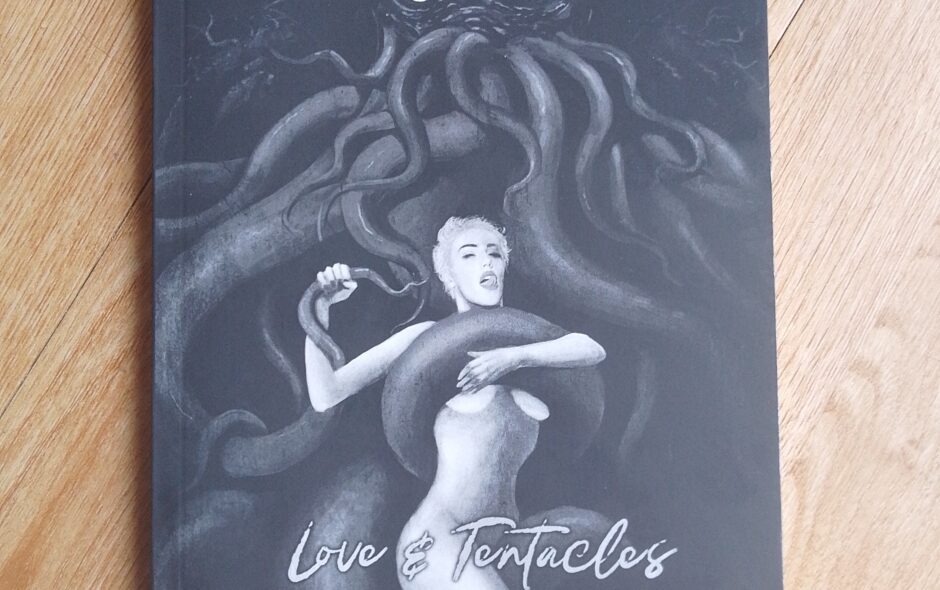
One of my favourite things as a reader is discovering books that turn out to be more than they appear. These books often masquerade as something traditionally defined as “low brow” entertainment, but in truth, they are deeper than their shocking titles or covers would indicate. Madness From The Sea: Cthulhu’s Lure is absolutely one such book. Whilst its hentai cover, depicting a woman pulling an orgasm face as Cthulhu’s tentacles envelope her, would indicate a shallow (though thrilling) bit of smut, Cthulhu’s Lure is so much more than mere tentacle-titillation.

The basic of premise of Cthulhu’s Lure will be familiar to fans of Lovecraft. Frances Smith, a young woman living in Boston, keeps receiving erotically charged dreams about a great squidlike entity that exists in a liminal dreamscape, a haunting “labyrinth of stone monoliths”. Unsure what she is experiencing, she does what most of us in the Twenty-First Century would do, and turns to the internet. It doesn’t take long for Frances to develop a cult following. Some of them are weirdos who are turned on by tentacle fetishes. But many are genuinely curious as to the meaning of her dream experiences.

Meanwhile, Donnie, Frances’ husband, is growing increasingly uneasy with his wife’s behaviour and wants to rescue their marriage. As Frances is drawn closer and closer into the labyrinth of her own desires and fantasies, Donnie—with the help of one of Frances’ friends, Hazel—takes drastic measures to prevent her from hurting herself and others.

There is a lot more to say, but to avoid spoilers, I will leave it there.

One thing I really loved about this story is how it genuinely tried to bring a modern twist to Lovecraft’s original tale. Whilst I enjoy modern Lovecraft fiction, in general I find it too often falls into the trap of trying to re-create the original. Cellphone signal is lost. Maps are destroyed. Time travel occurs. Essentially, the writer tries to avoid modern elements to imitate the same style of horror deployed in Lovecraft’s nineteenth-century stories. Whilst this can be fun for a bit of escapism, it ultimately feels contrived, and like an avoidance of the truth.

Jonathon T. Cross, however, takes on the modern world head on. He explores what a return of Cthulhu might look like in the modern age, and how the internet—a space that operates not unlike a shared dreamworld or an astral plane—would pay a huge part in such a resurgence. Whilst there are comedic moments in the story, overall the modern elements don’t take away from the atmosphere of dread but actually augment it, partly because it is all so believable. You may be looking at me like I’m crazy, but the idea of an internet community building exponentially and then bubbling violently over into the real-world, leaving chaos in their wake, is not only possible but probable in the near future.

Jonathon T. Cross also creates a link between his modern setting and the “old world”. He does this in several ways, but principally through the medium of dream, using the dream-world as a liminal space in which possibilities can coexist, including the communication between entities from beyond the stars and human beings. Whilst dream-sequences can be overused in fiction, the dream-world in Cthulhu’s Lure is a specific and well-used concept that not only serves narrative purpose but also reveals character. Symbolism within the dream is reflected in reality in clever and subtle ways. Likewise, desires expressed in the dream are corrupted and made manifest in the waking world. A dialogue exists between the phantasmal realm of myth and the modern world of crumbling materiality desperately clinging to a sense of meaning. Frances Smith is the middle point where all of this converges: old and new, technological and magical, intuitive and rational, mundane and extraordinary. She is the prophetess of a new age, a red woman sprung from Aleister’s Crowley’s lusty imaginings but instead of being wedded to the Ten Headed Beast she is wedded to Cthulhu.

As I said before, Cthulhu’s Lure is very far from tentacle-porn. In fact, its use of sex bears more in common with Greek mythology than with modern erotica. The concept of a beast or monster mating with a woman to produce theriomorphic offspring is pervasive throughout virtually all the ancient mythologies. Perhaps the most famous example of this is The Minotaur, a creature half-human and half-bull, born of the sexual congress between Pasiphaë and the favoured snow-white bull of Poseidon. Poseidon, of course, is the god of the sea, so there’s already a link, albeit tentative, between Cthulhu and the bull-monster of Greek legend.

Because of the Minotaur’s hybrid nature, Pasiphaë could not nourish the child, and so it became increasingly ferocious and bloodthirsty and eventually turned to devouring human beings for sustenance. The Minotaur is therefore imprisoned in a terrible labyrinth constructed by the genius inventor Daedalus. The Minotaur waits at the heart of the labyrinth, a black secret, devouring any who are sent as offering into its runnels.

Cthulhu likewise waits in the labyrinthine and “sunken” city of R’lyeh, accessible only via dream or by a perilous voyage across the Pacific Ocean. R’lyeh, the labyrinth, these dark and inaccessible spaces represent our unconscious, inhabited by the antediluvian urges that can still be awoken with the right ritual and sacrifice. In the modern world we have seemingly conquered these urges and desires, but we still fear their return, and the time is soon coming “when the stars are right” and these desires—symbolically represented by Cthulhu—will once more walk the earth and hold sway.

The other brilliant thing about Cthulhu’s Lure is that it for all its Lovecraftian and mythological trappings it remains the grounded story of a failed marriage. And despite all the messed up things done by both Donnie and Frances, you still care about both of them, and still sort of want things to work out. Jonathon T. Cross channels Lovecraft, but filters the anxiety, the paranoia, the obsession, and the madness through a totally new lens, producing something that feels like one of the most original takes on the mythos in quite some time.

You can read Cthulhu’s Lure in a single day (I know I did), yet it will take you on a deep journey into a woman’s fracturing psyche and a man’s desperation to save what little he has in life. The last line of the book is a real humdinger. And, I may be wrong, but it looks like there might be further books in the series to look forward to.

Jonathon T. Cross is definitely a writer to watch. You can check out more of his work over at https://www.thatspookybeach.com as well as cool art and other merch.

Blog

Review of In The Shadow of Their Dying by Anna Smith Spark and Michael R. Fletcher

In esoteric philosophy, it takes the combination of two polarised energetic forces in order to produce something new and original. The most obvious example of this is found in conception and childbirth. But the same applies in the intellectual and imaginative realms as well.

In The Shadow of Their Dying is one such original creation, sprung from the union of two giants of fantasy: Michael R. Fletcher, known as the Mad Titan of dark fantasy (what an epithet!), and Anna Smith Spark, Queen of Grimdark.

Having read both of these authors, I have to admit I was uncertain how their styles would effectively combine. Michael R. Fletcher writes in a stark and cerebral manner. His work explores powerful concepts and, at least in my view, seems primarily concerned with ideas. For example, in Beyond Redemption, his world is populated by Geisteskranken, individuals whose delusions are so powerful they manifest in physical reality. Fletcher uses this high-concept premise to explore the dark recesses of the human mind and our relationship with religion and belief. In many ways, his novel read to me like an allegorical tale, in which characters embody particular human delusions or desires or false beliefs. In this way, his work has a distinctly Spenserian vein.

By contrast, Anna Smith Spark’s epic Empires of Dust series is written in a deeply emotive and impressionistic style. Her story is not centred around precise plotting or logically worked out magic systems, but rather on the torrid and tumultuous emotional interiors of her characters; its these emotions, more than anything else, that drive them and the action. I compared Empires of Dust to The Iliad in my original review because, like Homer’s masterwork, it is the furyof Achilles that takes centre stage, not the politics of Troy and Greece.

My fears about how two such differing styles would combine were unfounded, however. In fact, the abilities each author brought to the table augmented and complimented the other beautifully. Fletcher’s sheer bleakness was lifted by Anna Smith Spark’s incredibly lush and stylish poetry. And conversely, Spark’s more abstract approach to narrative—which at times can be hard to follow—was grounded by Fletcher’s more concrete and direct approach, as well as beingilluminated by his jet black humour. Although it must be said both writers introduce comedy into their dark narratives in surprising ways.

But enough meditations on writing style. I should get to the plot!

In The Shadow of Their Dying is a story about three characters caught up in the midst of a terrible and pointless war. Though there are a host of players in the tale, our main protagonists are: the hapless yet cunning Tash, the “third best assassin in Sharaam”; Pitt, the leader of a curious gang of cutthroats and magical beings; and finally, Iananr, a demon bound in service to the King of Sharaam.

Clive Barker once wrote in his masterpiece Imajica that:

“It was the pivotal teaching of Pluthero Quexos, the most celebrated dramatist of the Second Dominion, that in any fiction, no matter how ambitious its scope or profound its theme, there was only ever room for three players. Between warring kings, a peacemaker; between adoring spouses, a seducer or a child. Between twins, the spirit of the womb. Between lovers, Death. Greater numbers might drift through the drama, of course – thousands in fact – but they could only ever be phantoms, agents, or, on rare occasions, reflections of the three real and self-willed beings who stood at the center.”

This is certainly true of In The Shadow of Their Dying, for it is these three players that constantly drive the action with their alliances and betrayals, their rises to power and subsequent falls, their changes of heart, and their reversions to their darker natures. Each perspective is unique. Tash is a strangely relateable narcissist who wants people to take him seriously and will do anything to ensure that. Pitt is an experienced manipulator who yet has a weak-spot for one woman in particular. And Iananr is perhaps the most fascinating perspective of all: she is a demon bound to human form, and her mind roves in ways that are utterly alien and almost incomprehensible to us.

In the structuring and styling of the story, both writers play to their strengths. It’s clear Anna Smith Spark handled the chapters written from the perspective of Iananr, using her gorgeously sensuous prose to conjure the unknowable thoughts and feelings of a being that is not truly of the flesh but of the spirit. At times, the writing almost becomes pure poetry, grammar and words bent out of all shape and recognition as they strain to evoke the labyrinthine mind of a creature that is more god than mortal. This is doubly appropriate, because it is with “words-chains”—a spell—that the demon is bound, and the demon is constantly meditating on the inadequacy and yet the hidden power of words.

By contrast, it’s clear Fletcher leant his hand to Tash’s chapters, his grimdark sensibilities rendering our assassin in delightful shades of morally grey. Tash is a loathsome human being, but strangely compelling. Comedy is interspersed with bloodshed and morally reprehensible acts in an almost Shakespearean fashion. The ultimate fate our assassin ishilarious and darkly fitting.

In The Shadow of Their Dying is only a novella, so the plot is neither grand nor sweeping. All the action takes place within the city walls of Sharaam. But this serves to up the tension and enhance the focus even further on the characters; in this way, the book feels almost like a play, and fittingly Tash wistfully reflects upon his own life as a play being written by a great playwright. Spark and Fletcher have created a darkly vibrant world despite the fact we only see a taster of it. They also take a few old tropes of the fantasy genre and remake them in gloriously inventive ways. Despite the plot not being the main focus of the story, there are a few wonderful surprises in store that will catch you unawares.

If I have one minor criticism, it is at times scenes are repeated from a different character’s perspective a few too many times for my taste, especially for a novella of this size. But this is a minor quibble, and the murky atmosphere of the story is sustained throughout.

In The Shadow of Their Dying is a gore-soaked, betrayal-filled, grimdark delight that yet hides a strangely spiritual core. It asks the question of what ties truly bind us to a life of misery, war, bloodshed, and addiction, and whether those ties might really be an illusion, and what might happen if we could free ourselves of those ties. The answers are not predictable, nor expected. And the characters we think are capable of redemption may, after all, be doomed to repeat their mistakes. And the characters we believe are irredeemable may yet surprise us.

I, for one, hope that we see another book from these two masters of the craft. A few threads have been left which could be used to weave a larger narrative. But even if we don’t see more, In The Shadow of Their Dying is a perfectly blendedshot of dark fantasy that burns the throat on the way down, and leaves an aftertaste as beautifully bitter as it is sweet.

You can purchase the novella here:

Amazon UK

Amazon US

Blog

New Release: Servants of the Dark Gods!

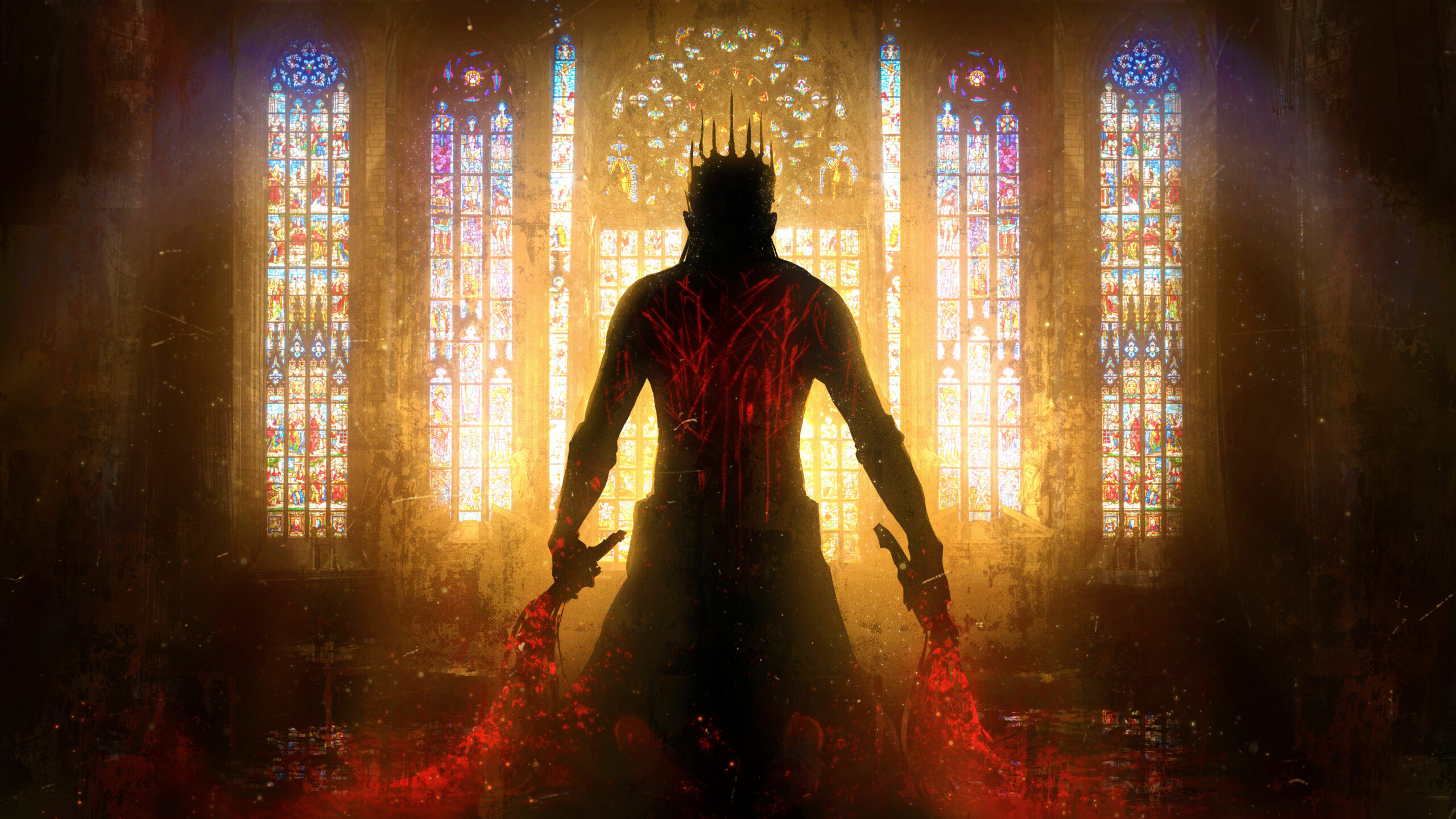
The silhouette of the king on his knees, he holds two whips for self-flagellation in the middle of a Gothic cathedral with bright sunny stained glass windows , his back is wounded and bleeding 2d art

Hello everyone,

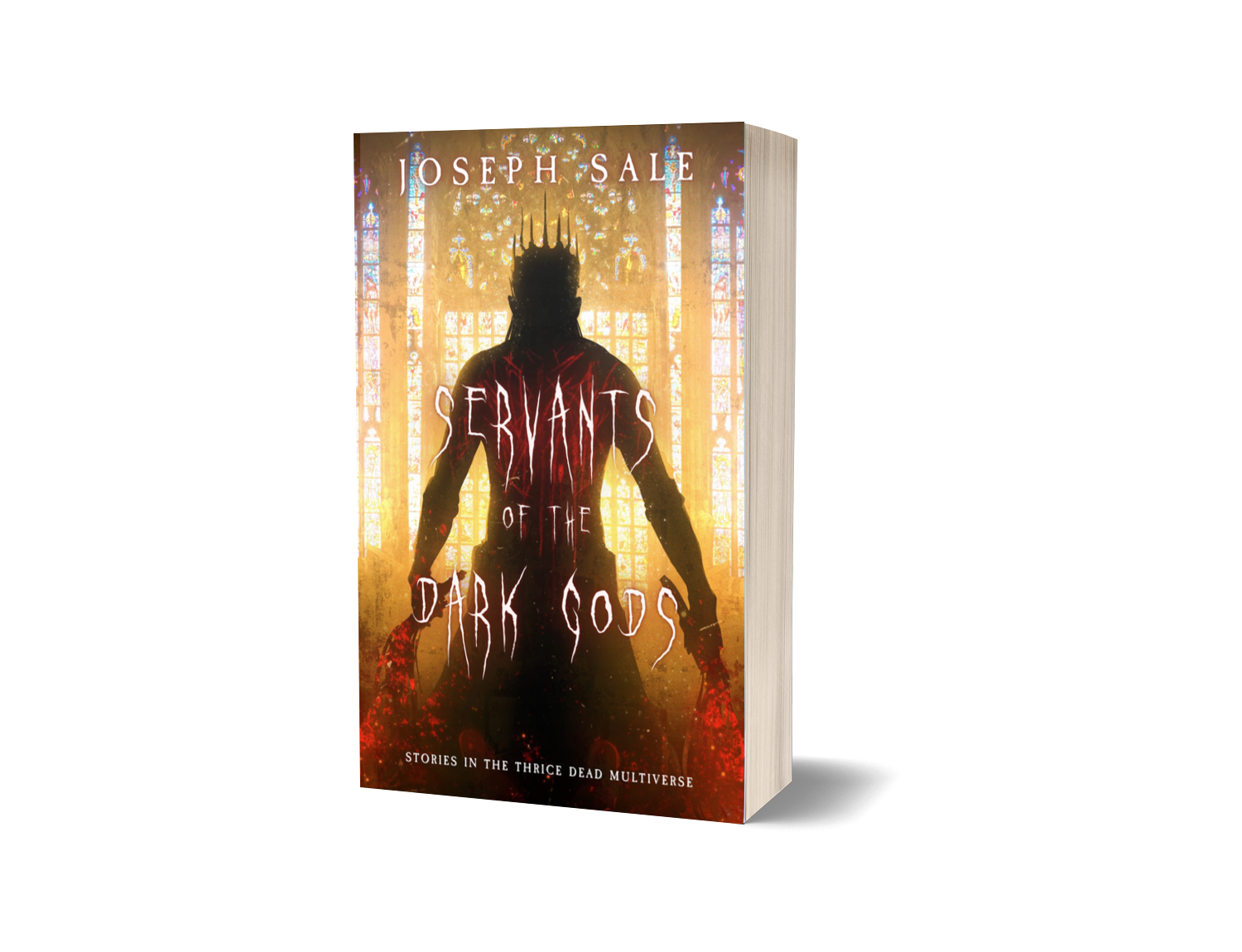
I am pleased to announce my new book SERVANTS OF THE DARK GODS will be released in May! See below the cover reveal!

This collection, set in The Book of Thrice Dead multiverse, pulls together six of my best and most horrifying short stories, three of my most popular dark novellas (including The Meaning of the Dark), and includes a new original short story entitled “Spring Offensive”.

Many of these stories have been out of print for several years, so it is a delight to see them in print again! These stories contribute to the wider lore and origin stories of the principle cast of The Book of Thrice Dead, so those familiar with this series will meet some old friends—and learn some surprising truths.

The stunning cover design was done by dear friend and awesome writer Dan Soule. The art is Warm Tail.

Furthermore, I am delighted to announce that the incredible Lezlie Smith, of The Nerdy Narrative booktube channel, has written a stunning Foreword for the collection. Honestly, it might be better than the stories themselves!

Here is a short extract:

“For those familiar with Sale's work, this collection offers a tantalizing glimpse into the origins of characters, tracing their paths through the web of existence to the precipice of villainy. For newcomers, it serves as a portal to worlds beyond imagination, where every story is a gateway to discovery and self introspection.”

You can view the Amazon pre-order page for more information:

Amazon US

Amazon UK

Amazon CA